
Why Do Entrepreneurs Chase New Marketing Tactics?
Entrepreneurs often chase new marketing tactics because they’re trying to find something that finally works.
With so many new platforms, tools, trends, and AI solutions constantly being promoted, it’s easy to believe the next tactic could be the answer.
The problem is that tactic hopping usually creates more confusion, inconsistency, and self-doubt when there is no clear strategy underneath it.
In many cases, the real issue is not a lack of effort, but rather, a lack of clarity around positioning, messaging, and what best fits your business.
Key Takeaways:
- Entrepreneurs often chase new marketing tactics because they want traction and do not want to fall behind.
- A tactic that works for one business may not work for another because every business has different positioning, offers, and audiences.
- Constantly switching tactics can make marketing feel reactive, inconsistent, and exhausting.
- Shiny object syndrome is often a symptom of unclear positioning, not the root problem itself.
- When positioning is clear, it becomes much easier to choose the right marketing tactics and ignore the wrong ones.
If you’re constantly wondering whether you should try one more platform, one more tool, one more trend, or one more marketing trick, you’re not alone.
Most entrepreneurs have had that moment.
You see someone talking about a new strategy that supposedly changed everything.
It could be a new social platform that’s gaining traction, or a new AI tool that promises to save you a bunch of hours.
At the same time, one coach says email is the answer, and another says short-form video is what you should be focusing on, while others swear it should be SEO, webinars, podcasting, live launches, automation, or personal branding.
So, you start thinking the problem isn’t your offer, and maybe you’re just missing the right tactic.
That thought is what keeps many business owners in motion, but not always in the right direction.
Years ago, I wrote about a phenomenon among entrepreneurs that I called shiny object syndrome.
It was real then, and it’s still real now.
But the difference is today the number of distractions has multiplied exponentially.
Business owners aren’t just being pulled by new software or new social media features. They’re being pulled by an endless stream of new marketing tactics, all presented as the missing piece.
And that’s why this issue matters more than ever.
The temptation to chase what’s new is often a sign that the strategic foundation underneath your marketing has not been fully defined.
What Makes New Marketing Tactics So Tempting?
Entrepreneurs are builders by nature.
You’re wired to look for opportunities, you’re used to solving problems, and you’re willing to move fast when something feels promising.
Truth be told, that can be a huge strength in business, but it can also make you highly vulnerable to distractions.
Every week there seems to be a new marketing tactic worth considering.
A new platform gets attention, a new content style starts performing well, a new AI tool promises faster copy, better ideas, easier systems, or more visibility, and a new expert shares a success story that sounds simple enough to copy.
On the surface, this all seems responsible.
You want to stay current. You want your business to grow. And you don’t want to fall behind.
But that’s where things get tricky.
Staying informed is smart, but constantly changing direction is not.
It’s important to point out that many entrepreneurs do not chase new marketing tactics because they’re careless.
They chase them because they’re trying to get traction or trying to solve some kind of problem.
And ultimately, they’re just trying to make their marketing work.
So, you keep testing, tweaking, and starting over, which can turn into a pattern of reacting to whatever is newest, instead of choosing what actually fits your business.
Why Those Tactics Sometimes Work for Other People
One of the biggest reasons entrepreneurs get pulled off track is that they see someone else succeed with a tactic and assume the tactic itself is the reason.
The truth is sometimes it is. But at the same time, many times, it’s not.
Like it or not, a strategy that works beautifully for one business may fail completely for another.
And that’s because tactics do not exist in a vacuum.
They sit on top of context.
That context includes your business model, your offer, your audience, your price point, your brand positioning, your customer journey, and the credibility you’ve already built around your business.
The truth is a business with a clear niche, a strong offer, and a loyal audience can often make tactics work faster.
But a business with muddy messaging, broad positioning, or weak trust signals may use that exact same tactic and get disappointing results.
And this is why copying other businesses’ strategies can be so frustrating.
Oftentimes, you’re just seeing the visible part of their strategy, and not the structure underneath it.
You see the Instagram reel, but you don’t see the years of authority they built, the clarity behind their messaging, their AI-generated content system, or the work they’ve done on their brand voice to make sure it sounds human and trustworthy.
And when you choose to ignore that, you can end up believing something is wrong with you or your business when the real issue is that you’re trying to apply someone else’s tactics when they may or may not be relevant to your business.
Read: 9 Common AI Marketing Errors That Can Sabotage Your Brand Positioning

If you’re an entrepreneur, chances are, you’re going to use AI in your marketing.
That part is pretty much a given now, but if you choose to use AI without a clear strategy, you can end up doing serious damage to your brand positioning.
With that in mind, this is an important read if you want to use AI without hurting the credibility, connection, and positioning your brand depends on.
The Hidden Cost of Tactic Hopping
At first, chasing new marketing tactics can feel productive, as you’re researching, you’re trying, and you’re taking action.
But over time, tactic hopping creates a subtle kind of damage.
Your marketing becomes reactive, so instead of following a strategy, you start responding to whatever caught your attention this week.
Your messaging becomes inconsistent, as each new tactic often comes with a slightly different angle, different tone, or different focus.
And before long, your audience starts seeing mixed signals.
Your energy gets drained because starting over all the time is exhausting. Learning new tools, changing plans, rewriting content, and second-guessing what to do next eats up more energy than most entrepreneurs realize.
What’s more, your confidence starts slipping, and that’s one of the biggest costs.
In any case, when you keep trying new things without seeing clear results, it becomes easy to believe the problem is your discipline, your content, your personality, or a lack of ability to market your business.
You begin to wonder why marketing seems easier for everyone else, as you question your decisions, and you lose trust in your own judgment.
And once that kind of self-doubt gets involved, even simple marketing decisions start to feel difficult to make.
So, you hesitate, you overthink, you delay, and then you chase the next idea because it gives you a brief sense of hope.
Unfortunately, that cycle is hard to break when you think the problem is that you just haven’t found the right tactic yet.
Why Shiny Object Syndrome Is Often a Symptom, Not the Problem
This is the part many business owners miss.
Shiny object syndrome is often not the root problem. It is a symptom.
And it usually shows up when clarity is missing.
Because when your brand positioning is unclear, almost every tactic seems like it’s worth trying.
At the same time, when your message is not fully defined, every expert sounds like they might have the answer, when your audience is too broad, every platform feels like it could matter, and when your offer isn’t clearly framed, every marketing trend feels like a possible fix.
That’s why tactic chasing can feel so intense.
If you don’t know exactly how your business should be positioned in the market, how your value should be communicated, or what makes you the right choice for the right client, then it becomes much harder to direct your marketing with confidence.
You stay open to everything because nothing has been ruled out.
And this is where many entrepreneurs get stuck.
They think they need more tactics, but what they often need first is more clarity.
Clarity about whom they serve, what problems they solve, how they’re different, what their audience needs to hear before they trust, engage, and buy, and clarity on which marketing channels actually support the business they’re trying to build.
Without that clarity, new marketing tactics will keep looking more valuable than they really are.
What Changes When Your Brand Positioning Is Clear
When your brand positioning is clear, marketing decisions get much simpler.
Not easy all the time, but simpler.
You stop looking at every trend as an opportunity you might be missing, and you start asking a better question, which is, “Does this fit my business?”
And that one shift changes a lot.
It becomes easier to say no to tactics that don’t align, and easier to invest in the few channels that make the most sense for your business.
Moreover, it becomes easier to create content with consistency because the message underneath it isn’t changing every week.
It also becomes easier to use AI wisely because you’re not asking it to invent your strategy for you. You’re using it to support a strategy that’s already clear.
And it becomes easier to trust yourself because your decisions are no longer being made from panic, comparison, or fear of missing out.
At any rate, clear brand positioning acts like a filter.
It helps you separate what’s interesting from what’s actually useful, allows you to stop chasing every tactic that gets attention, and helps you choose marketing activities that reinforce your authority instead of scattering it.
Most importantly, it helps your audience understand you faster.
And when people understand what you do, whom you help, and why your business is different, your marketing starts working from a much stronger place.
The Goal Isn’t to Do Less Marketing, It’s to Do the Right Marketing
Despite what I’ve said thus far, entrepreneurs don’t need to stop learning.
They don’t need to ignore change, and they don’t need to avoid every new tool or new idea.
That’s not the point here.
The goal is not to reject new marketing tactics, but instead to stop giving them too much power.
Because a tactic is only useful when it supports a clear strategy.
Without that, even smart marketing can turn into nothing but noise.
This is why so many business owners feel like they’re working hard without getting enough return.
They’re putting effort into their marketing, but the foundation underneath it is still unclear.
And when the foundation is unclear, more tactics will rarely fix the problem.
So, if you’ve been bouncing from one idea to the next, feeling pulled in too many directions, or wondering why your marketing still feels harder than it should, this may be the real issue.
Tired of chasing new marketing tactics without seeing results?
Book a free consultation today to stop chasing what’s new and start building what works.
To your business success,
Susan Friesen
P.S. If you liked the article, you might want to subscribe to our newsletter. We publish tons of valuable content to help you learn more about marketing, and subscribing is the best way to ensure you don’t miss out. Additionally, if you’d like to learn more about building a search engine optimized website, click here for our free website guide.
Ready to Attract Better Clients Without Working Harder?

You don’t need another crash course in funnels or hacks. You need clarity.
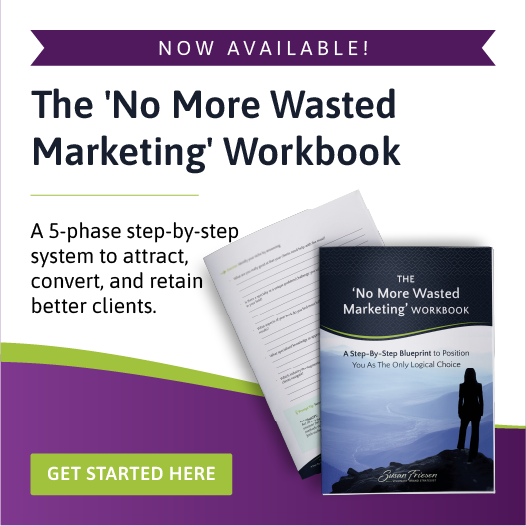
And that’s exactly what you’ll get in The ‘No More Wasted Marketing’ Workbook, a step-by-step guide to help you refine your brand positioning and uncover what makes your business stand out.
This isn’t just a workbook. It’s your roadmap to:
- Marketing that finally feels like it's working
- Offers that feel like a perfect fit (because they are)
- Magnetic messaging that speaks to your ideal client
- A brand that builds trust and authority at first glance
So, if you’re tired of attracting the wrong clients, or none at all, it’s time to change that.
Download The ‘No More Wasted Marketing’ Workbook Now and start building the kind of brand that your best clients just can’t ignore.

About the Author, Susan Friesen
Located in the lower mainland of B.C., Susan Friesen is a visionary brand strategist, entrepreneur, and founder of British Columbia’s premiere boutique web development and digital marketing agency, eVision Media.
With over 20 years of experience in the industry, she is an expert in helping businesses establish their online presence and create a strong brand identity.
Her passion for empowering entrepreneurs and small business owners to succeed in the digital world has earned her a reputation as a leading authority in the branding and marketing industry.
Visit www.BrandIdentitySteps.com and download your FREE guide: "Unlocking Customer Trust and Business Growth: Your 7-Step Guide to Defining a Compelling Brand Identity that Appeals to Your Perfect Clients".