
Why Does My Marketing Give Inconsistent Results?
Your marketing results may feel inconsistent because individual tactics are creating short bursts of attention, but the strategy underneath them is not strong enough to keep that attention moving in a clear direction.
A post may get some engagement, a newsletter may spark a few replies, and a campaign may bring in some leads.
But if your message is unclear, your audience is too broad, your offer isn’t positioned clearly, or your website doesn’t support the interest being created, those short bursts may not turn into steady momentum.
Key Takeaways:
- A short burst of attention is not the same as steady momentum.
- Inconsistent marketing results don’t always mean the tactic failed.
- Changing tactics too quickly can restart the same frustrating cycle.
- Your message, offer, website, and positioning all affect consistency.
- Stronger foundations help your marketing decisions feel clearer and less reactive.
For a while, your marketing seems to be working.
A lead comes in, a few people reply to your newsletter, a social media post gets more comments than usual, and a previous lead reaches out again.
At some point, it starts to give you that spark of encouragement and you think, “Okay, maybe this is finally starting to work.”
But then things slow down.
The replies stop, the inquiries slow down, and the engagement drops off.
What’s worse, you keep doing what you were doing, but the results are no longer the same.
Hands down, this is one of the most frustrating parts of marketing.
Because it’s not always that your marketing doesn’t work at all. Sometimes it works just enough to make you feel hopeful, but then it suddenly stops working again.
And that inconsistency can make you question everything.
Was it the content? The offer? The timing? The platform? Something you said? Or did the algorithm change again?
In any case, when your marketing works one week but falls flat the next, it can be incredibly demoralizing, not least because it becomes hard to trust your own decisions.
The Cycle of Bursts, Then Silence
Many entrepreneurs know this cycle well.
You write the posts, you send the emails, you update your website, and you try to stay visible.
But then something happens.
A post gets some activity, a campaign gets signups, a lead books a call, and a few people finally show some interest.
And for a brief moment, it feels like the effort is paying off. But then the momentum disappears.
The same type of post no longer gets the same response, your email list stops growing, the calls only trickle, and the leads that seemed so promising fail to continue.
This can feel especially confusing because your marketing did work, at least for a while. And that can make it harder to know what to fix.
When something never works, you can usually decide whether it was the wrong tactic, the wrong audience, or the wrong message.
But when something works briefly and then stops, it creates a different kind of uncertainty.
You wonder whether you should keep going, change direction, or try something else entirely.
And that is where many business owners get stuck.
The Hardest Part Is Not Knowing Why It Changed
The most difficult part of inconsistent marketing isn’t always the slowdown itself – it’s not knowing what caused it.
When your marketing gets a response, you may not know exactly why. Was it the topic? Were you more visible that week? Was someone already close to making a decision?
And when the number of responses drops off, you may not know why that happened either.
This lack of clear cause and effect creates second-guessing.
Before long, your marketing starts to become an ongoing experiment where every result sends you in a different direction.
Some testing is healthy, but there’s a difference between thoughtful testing and constantly reacting to everything.
And when every slow week makes you question your entire marketing strategy, your marketing is bound to become emotionally draining.
As a result, you’ll stop building from a clear direction and start responding to whatever happened most recently, and that is a hard way to grow.
Why the First Reaction Is Usually Another Tactic
When results slow down, the natural response is to do something.
You may feel pressure to post more often, try a new platform, change your content style, create a new lead magnet, run ads, rewrite your offer, send more emails, or try the strategy someone else said worked for them.
To be fair, there’s nothing wrong with changing tactics when there’s a good reason to do so.
But the problem happens when every change is made because you’re trying to escape uncertainty.
It’s true that a new tactic can create a short burst of attention, and that can make it seem like the change solved the problem.
But if the deeper foundation hasn’t been strengthened, then the same pattern often returns.
There’s activity, but then silence. Then another change, and yet another slowdown.
This cycle can make you feel like you’re working hard at marketing without ever building any real momentum.
As a result, you may begin to think marketing doesn’t work for your business when the real issue may be that each tactic is being asked to do too much on its own.
Read: Why Hard Work Alone Won’t Fix Your Marketing (and What Will)

If this piece has been hitting close to home, you may also find this article helpful.
It explores several places where your marketing can break down, including unclear messaging, weak targeting, an outdated website, and offers that aren’t connecting with the right people.
What’s more, it’ll help you think through your message, your strategy, and the deeper reasons your marketing doesn’t work the way it should.
A Tactic Can Create a Response Without Creating Stability
A marketing tactic can absolutely work.
A social post can bring in an inquiry, a newsletter can lead to a conversation, a webinar can attract new leads, and a Google ad can send traffic to your website.
But the tactic itself is not the problem here.
The problem begins when the tactic isn’t connected to a clear enough direction.
Because when someone notices you, they may look at your website, check out your services, compare you with someone else, and ask themselves whether they trust you enough to reach out.
But that moment of interest needs support.
And if your message is unclear, then that interest might fade.
If your website doesn’t reflect the quality of your work, then the person may hesitate.
If your offer is too broad, then they may not see themselves in it.
And if your positioning is weak, then they may see you as one option among many instead of the right fit for their specific needs.
In any case, this is why short-term responses don’t always turn into steady results.
The tactic may have done its job by getting attention, but attention still needs direction.
What the Inconsistency May Be Pointing To
When marketing results keep rising and falling, it may be worth looking beneath the surface.
This doesn’t mean something is wrong with your offer, that you’re bad at marketing, or that the tactic failed.
But what it may mean is that the foundation underneath your marketing isn’t strong enough yet to support more consistent results. For instance:
- Your message may be unclear. You may be explaining what you do, but not clearly enough why it matters to the person reading it.
- You may be trying to appeal to too broad an audience. When you try to speak to too many different types of people, your message becomes too general.
- Your website may be outdated or vague. This can cause people to lose interest and leave before they take time out of their day to inquire.
- Your offer may not be positioned strongly enough. You may have a valuable service, but if it sounds similar to what others offer, people may not know why they should choose you.
A Better Question Than “What Should I Try Next?”
When marketing slows down, the question many business owners ask is, “What should I try next?”
That question makes sense because it feels active, practical, and gives you something to do.
But it may not be the most useful question.
A better question is, “What foundation is my marketing actually built on?”
That question shifts your thinking.
Because instead of chasing another tactic, you’ll begin looking at whether your marketing has enough structure to support the results you want.
At this point, you should ask yourself:
- Do my offers make sense to the people I want to reach?
- Am I speaking clearly to the people I most want to attract?
- Does my website help build trust once someone becomes interested?
- Is my content reinforcing a clear position, or am I simply trying to stay active?
- Is my message consistent enough for people to remember what I want to be known for?
These questions may not feel as urgent as trying a new tactic. But they’re often far more useful.
And that’s because when your foundation is weak, every tactic struggles to achieve its goals.
Every post has to explain too much, every email has to rebuild context, every sales conversation has to correct confusion, and every website visitor has to figure out if they’re in the right place.
Before You Change the Tactic, Look at the Foundation
If your marketing works sometimes but then suddenly slows down, it doesn’t automatically mean you need to start over.
It may not mean you need a new platform, more posts, or a completely new offer.
What it may mean is your tactics are creating short-term activity, but the foundation underneath them needs more strength and direction.
And that’s an important distinction because when you assume the tactic is the problem, you can spend a lot of time changing things that were never the real issue.
So, before you switch platforms, rewrite everything, or start following another marketing trend, you should take a moment to pause and ask yourself:
- Is my positioning clear?
- Is my message specific?
- Is my website supporting the interest my marketing creates?
- Am I speaking to the right people in a way that makes them feel understood?
- Are my marketing efforts connected to a larger strategy, or are they operating as separate attempts to get attention?
All things considered, your marketing doesn’t need to feel like a constant guessing game.
When your foundation is stronger, your decisions become clearer, your message becomes steadier, and your tactics have a clearer job to do.
What’s more, you’re less likely to keep chasing the next trend every time you don’t get the kind of results you want.
If your marketing feels unpredictable and you’re tired of guessing what to change next, we can help you look at what may be happening beneath the surface.
Book a free consultation today and let’s talk about how we can make your marketing more consistent.
To your business success,
Susan Friesen
P.S. If you liked the article, you might want to subscribe to our newsletter. We publish tons of valuable content to help you learn more about marketing, and subscribing is the best way to ensure you don’t miss out. Additionally, if you’d like to learn more about building a search engine optimized website, click here for our free website guide.
Ready to Attract Better Clients Without Working Harder?

You don’t need another crash course in funnels or hacks. You need clarity.
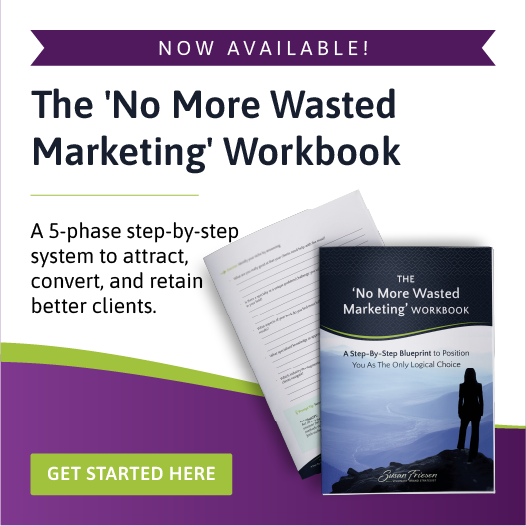
And that’s exactly what you’ll get in The ‘No More Wasted Marketing’ Workbook, a step-by-step guide to help you refine your brand positioning and uncover what makes your business stand out.
This isn’t just a workbook. It’s your roadmap to:
- Marketing that finally feels like it's working
- Offers that feel like a perfect fit (because they are)
- Magnetic messaging that speaks to your ideal client
- A brand that builds trust and authority at first glance
So, if you’re tired of attracting the wrong clients, or none at all, it’s time to change that.
Download The ‘No More Wasted Marketing’ Workbook Now and start building the kind of brand that your best clients just can’t ignore.

About the Author, Susan Friesen
Located in the lower mainland of B.C., Susan Friesen is a visionary brand strategist, entrepreneur, and founder of British Columbia’s premiere boutique web development and digital marketing agency, eVision Media.
With over 20 years of experience in the industry, she is an expert in helping businesses establish their online presence and create a strong brand identity.
Her passion for empowering entrepreneurs and small business owners to succeed in the digital world has earned her a reputation as a leading authority in the branding and marketing industry.
Visit www.BrandIdentitySteps.com and download your FREE guide: "Unlocking Customer Trust and Business Growth: Your 7-Step Guide to Defining a Compelling Brand Identity that Appeals to Your Perfect Clients".