
I’m sure you’ve put countless hours and substantial resources into your marketing efforts.
By this point, you may have already redesigned your website, invested in social media campaigns, sent out newsletters, and even experimented with some paid ads.
But despite all these efforts, something still feels a bit off.
Your ideal clients aren’t responding, your time and efforts haven’t brought you the sales you’d hoped, and you’re left feeling frustrated and questioning why your marketing isn’t working.
But the reality is it’s not necessarily your tactics that are the issue.
In my experience, more often than not, the problem is a lack of proper brand positioning.
So, if you want to stop wasting marketing dollars and start building a solid foundation for all your future marketing efforts, then this article is for you.
If Your Marketing Isn’t Working, It’s Probably Your Brand Positioning
Brand positioning is the strategic process of shaping how your brand is perceived in relation to your competitors and in the minds of your target audience.
Among other things, this clarifies exactly who your ideal clients are, precisely what problems you solve, and why you’re better at solving those problems than your competitors.
But when your brand positioning is unclear or inconsistent, your marketing messages will become diluted, vague, or ineffective.
And no matter how sophisticated your marketing tactics might be, they won’t deliver results if that foundational clarity is missing.
Here are some common signs that your brand positioning could use some work:
- Your website and marketing materials are not getting you qualified leads.
- Competitors are constantly outshining you.
- Potential clients are interested, but they rarely convert.
- You find yourself contemplating lowering your prices to generate more business.
So, if it feels like your marketing isn’t working, and these symptoms sound familiar, then your brand positioning is the first issue you need to address.
Why Brand Positioning Is Critical
Think of your marketing as a house.
Without a solid foundation, even the most beautifully constructed house won’t be able to withstand storms.
Similarly, without clear and compelling brand positioning, your marketing will lack stability and clarity.
Clear positioning ensures your audience will immediately understand your value. It makes your marketing messages more consistent and focused, which will make them much more effective.
Common Mistakes in Brand Positioning and How to Avoid Them
After working in this industry for more than two decades, I’ve pretty much seen it all when it comes to mistakes in marketing and brand positioning.
Below you’ll find some of the most common mistakes I’ve seen business owners make when it comes to their brand positioning and some practical advice to help you avoid making these mistakes yourself.
Mistake #1: Trying to Appeal to Everyone
One all-too-common error I’ve seen over and over again is when businesses cast too wide a net.
Because if you try to appeal to everyone, you’ll likely resonate with no one.
And this results in generic, diluted messaging that leaves potential clients unsure of why they should choose you.
If you want to avoid making this mistake, you should clearly define who your ideal clients are.
Dig deep into their demographics (e.g. age, income, occupation), psychographics (e.g. values, interests, fears, challenges), and specific desired outcomes, and then focus your marketing messages directly toward that audience.
Mistake #2: Self-Centric Messaging
Many businesses focus their messaging solely on their own achievements or credentials.
But the truth is, your audience doesn’t really care about any of that, at least not nearly as much as they do about their own needs and desired results.
So, make sure to shift your messaging to focus on your clients’ outcomes and benefits, positioning them as the hero of the story and your brand as the guide.
What’s more, you should also clearly articulate how you can solve their specific problems and enhance their lives or businesses.
Mistake #3: Vague or Undefined Unique Selling Proposition (USP)
Without a clearly articulated USP, potential clients are going to have a pretty tough time differentiating your business from competitors.
And if you’re not standing out from the crowd, potential clients are likely to choose someone else.
If you want to avoid this mistake, you’ve got to clarify exactly what makes you unique.
In doing so, you should ask yourself questions like:
- What do I deliver that competitors can’t?
- How does my method differ significantly?
- Why do my current clients prefer me?
Then, once you’ve figured all of that out, you can convert your answers into a succinct USP that will help to anchor your marketing.
Read: Crafting a Unique Selling Proposition: Unleashing the Power of Your Brand

If it feels like your marketing isn’t working, chances are you still haven’t defined your unique selling proposition (USP).
But if you’ve never done this before, then creating one is definitely a lot easier said than done.
With that in mind, this article details what a unique selling proposition is, explores the benefits of having one, and explains what you can do to come up with one of your own.
Practical Steps to Refine Your Brand Positioning
The process of refining your brand positioning can be incredibly overwhelming.
But going through a series of intentional steps can make the process much easier, less daunting, and more enjoyable.
Here’s how I’d recommend you go about refining your brand positioning:
Step 1: Perform a Thorough Brand Audit
Before you do anything else, you should begin by examining the way your brand is currently being perceived.
Start by reviewing all of your existing marketing materials, including your website and social media.
Next, try getting some feedback from trusted clients by asking them questions like:
- What problem did we solve for you?
- Why did you choose us instead of a competitor?
- How would you describe our business to someone else?
Then use their responses to assess how accurately your intended brand positioning aligns with the perceptions of your current clients.
Step 2: Develop a Clear Brand Statement
Another important aspect of refining your brand positioning is ensuring you can easily explain what your brand is all about and what it has to offer.
And one of the best ways to do that is by creating a brand statement that succinctly communicates your identity, your target audience, and your unique offering.
Here’s an example of a brand statement that could be used by a health coaching service:
We help busy working mothers achieve lasting health and wellness through personalized virtual coaching programs, so they can enjoy more energy, reduced stress, and a balanced lifestyle. And unlike traditional gyms, our tailored online plans fit seamlessly into their demanding schedules.
In any case, make sure your brand statement clearly reflects your specific audience, highlights the unique value you offer, and differentiates you from your competitors.
Step 3: Align All Communications With Your Brand Positioning
If it feels like your marketing isn’t working, one of the reasons for that could be that your communications aren’t consistently aligned with your brand positioning.
So, make sure to audit your website content, social media posts, email campaigns, and even print materials to make sure they’re aligned and adjust them, if necessary.
This kind of consistency is a lot more important than you might think, as it makes you look more reliable and professional, helps to build trust, and reinforces your unique positioning in the minds of potential clients.
Step 4: Implement Regular Reviews
Your brand positioning isn’t just some static entity; it’s a dynamic aspect of your business that will undoubtedly change over time.
This makes it vital to regularly review your positioning by gathering client feedback, monitoring industry trends, and watching what your competitors are doing, while adapting and refining, as needed.
Step 5: Create Strategic Content Aligned With Your Positioning
Another great thing you can do if you want to improve your brand positioning is to develop valuable content that highlights your expertise and reinforces your unique selling proposition.
Consistent, high-value content such as blogs, videos, podcast interviews, and webinars all help to further establish your authority, credibility, and visibility.
Step 6: Leverage Testimonials and Social Proof
It’s also a good idea to showcase any client testimonials and case studies you have that are aligned with your brand positioning.
These kinds of authentic stories from satisfied clients help to reinforce your credibility and highlight the type of tangible outcomes that your ideal clients are looking for.
Step 7: Train Your Team to Reflect Your Positioning
Another very important step in this process, and one that unfortunately tends to get overlooked, is to ensure everyone in your organization clearly understands your positioning and can communicate it concisely and consistently.
This may require you to provide scripts, guidelines, or regular training, but whatever you do, just make sure everyone on your team understands your positioning and can easily explain it.
The Transformational Impact of Clear Brand Positioning
By addressing your brand positioning first, you’ll set your marketing efforts up for sustainable, meaningful success.
Your ideal clients will immediately understand why they should choose you, your messaging will become clear, compelling, and effective, and you’ll naturally attract higher-quality clients, which reduces your reliance on aggressive sales tactics.
What’s more, competitors will find it much harder to replicate your unique position in the market.
Ultimately, clear brand positioning elevates your business from competing on price or tactics alone to attracting clients based on true value and differentiation.
And when the foundation of your brand positioning is rock solid, every other aspect of your marketing will function more smoothly.
You’ll stop wasting marketing dollars and stop making so many mistakes in your marketing, which will help you to stop feeling frustrated and start feeling like your marketing is actually working.
To your business success,
Susan Friesen
P.S. If you liked the article, you might want to subscribe to our newsletter. We publish tons of valuable content to help you learn more about marketing, and subscribing is the best way to ensure you don’t miss out. Additionally, if you’d like to learn more about building a search engine optimized website, click here for our free website guide.
Ready to Attract Better Clients Without Working Harder?

You don’t need another crash course in funnels or hacks. You need clarity.
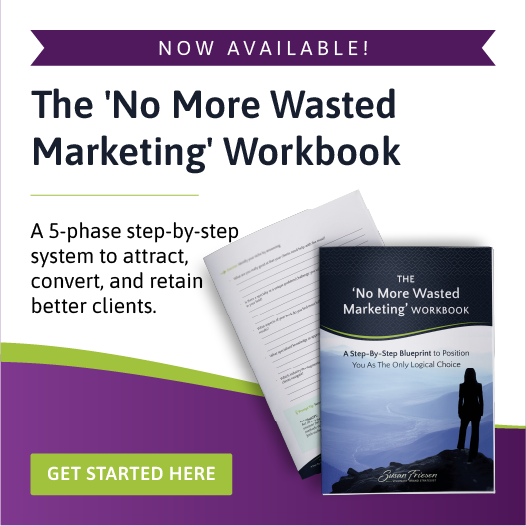
And that’s exactly what you’ll get in The ‘No More Wasted Marketing’ Workbook, a step-by-step guide to help you refine your brand positioning and uncover what makes your business stand out.
This isn’t just a workbook. It’s your roadmap to:
- Marketing that finally feels like it's working
- Offers that feel like a perfect fit (because they are)
- Magnetic messaging that speaks to your ideal client
- A brand that builds trust and authority at first glance
So, if you’re tired of attracting the wrong clients, or none at all, it’s time to change that.
Download The ‘No More Wasted Marketing’ Workbook Now and start building the kind of brand that your best clients just can’t ignore.

About the Author, Susan Friesen
Located in the lower mainland of B.C., Susan Friesen is a visionary brand strategist, entrepreneur, and founder of British Columbia’s premiere boutique web development and digital marketing agency, eVision Media.
With over 20 years of experience in the industry, she is an expert in helping businesses establish their online presence and create a strong brand identity.
Her passion for empowering entrepreneurs and small business owners to succeed in the digital world has earned her a reputation as a leading authority in the branding and marketing industry.
Visit www.BrandIdentitySteps.com and download your FREE guide: "Unlocking Customer Trust and Business Growth: Your 7-Step Guide to Defining a Compelling Brand Identity that Appeals to Your Perfect Clients".