
What Do Businesses Get Wrong When Posting on Social Media?
Many businesses get posting on social media wrong because they focus on their level of activity instead of the reasons why they’re posting.
They copy influencer tactics without considering whether their business model will even benefit from that, or whether it depends on attention, authority, or direct product sales.
Most importantly, they fail to define what each post is meant to accomplish before publishing it.
But when posting on social media is not aligned with how your business actually generates revenue, then you’re definitely doing something wrong.
Key Takeaways:
- Service providers should prioritize trust and credibility over reach and trends.
- Product-based businesses can post more directly about offers, but strategy still matters.
- Posting on social media without a clear objective leads to misalignment and inconsistent results.
- Influencer tactics do not automatically work for service-based or authority-driven businesses.
- Before making a post, you should define what the post is designed to accomplish and measure its success accordingly.
For many businesses, posting on social media has become pretty much automatic.
It’s on the checklist, it’s in the marketing plan, and it’s something you “should” be doing.
But oftentimes, what businesses get wrong when posting on social media is that they believe activity is the same as strategy.
In any case, I’ve spoken with countless service-based business owners who feel frustrated with social media.
They’re creating videos, sharing valuable content, and trying to be consistent, and yet, nothing feels like it’s making a difference.
In these instances, the issue usually isn’t a lack of effort, but rather a misalignment.
Most businesses never stop to define why they’re posting on social media in the first place.
They copy what they see others doing, follow the latest trends, increase the frequency of their posts, and try out new formats.
But the real question is rarely asked: What is this post designed to accomplish?
When you don’t know the answer, your post will inevitably blend into the sea of noise floating around on social media. And noise rarely builds trust, authority, or revenue.
So, to understand why this happens, let’s start by looking at three very different reasons for posting on social media.
1) Posting on Social Media as an Influencer
The first category we’re going to cover is the influencer.
Influencers post on social media to build attention. Their currency is audience size, and their revenue often comes from sponsorships, affiliate partnerships, brand deals, or monetized platforms.
And their goal is reach.
That means high frequency, trend participation, relatable, personality-driven content, entertaining formats, and rapid content cycles.
What’s more, influencers are rewarded for visibility.
The algorithm favours engagement, engagement fuels growth, and that growth fuels monetization.
There is nothing inherently wrong with this model, and it works very well for people who are intentionally building a business around attention.
But the problem is that most service-based businesses are not influencers, yet many copy influencer tactics when posting on social media.
They believe they need to post daily, they feel pressure to participate in every trending audio clip, and they assume higher volume always equals better results.
But if you’re not monetizing attention, then chasing attention may not serve you.
Posting on social media like an influencer when you’re selling your expertise can dilute your brand positioning, create exhaustion, and shift focus away from depth and toward distraction.
Influencer tactics are designed to grow an audience, but they’re not great for building authority or selling high-trust services. And that distinction matters.
2) Posting on Social Media to Build Trust and Authority
This is what most service-based businesses should focus on.
If you’re an HR consultant, legal professional, executive coach, wellness practitioner, financial advisor, or strategist, for instance, you are not selling attention.
What you’re selling is trust.
Your prospects are not asking, “Is this person entertaining?” They’re asking, “Is this person credible?”
And that changes how posting on social media should look.
When your goal is to build authority, the purpose of posting on social media is to:
- Share insight
- Provide proof
- Reinforce your values
- Demonstrate thinking
- Clarify complex ideas
- Show your methodology
This kind of authority-driven posting is slower, it’s more intentional, and it often requires fewer posts, not more, as it focuses on clarity rather than virality.
You’re not trying to reach everyone. You’re just trying to resonate with the right people.
In any case, authority is built through consistency, perspective, and depth, not through trends.
A thoughtful post explaining how you approach client challenges may generate fewer likes than a trending video. But it will attract much better conversations, and possibly better clients.
And that means posting on social media should support your positioning, not performance metrics.
Reach is not the primary goal, but trust is.
3) Posting on Social Media to Sell Products
The third category we’re going to explore is product-based businesses.
If you sell physical products, digital downloads, courses, or low-ticket offers, your approach to posting on social media should look different from that of influencers and those looking to build trust.
Product sellers are often more direct.
They can post about offers regularly, and they can highlight features, promotions, urgency, and limited-time pricing.
The buying decision is typically faster, and the trust barrier is lower, which allows for repetition and clear calls to action.
All things considered, this strategy revolves around awareness and transactions.
But the real confusion happens when service providers adopt this kind of product-style posting.
They constantly promote and push offers without building context, and expect direct sales from people who barely know them.
High-trust services require more relational depth than most products, and when your social media presence does not account for that, results tend to suffer.
Again, the issue is not the platform. It’s misalignment.
Read: 5 Social Media Mistakes That Are Quietly Hurting Your Business

If you’re starting to rethink your current approach, this article on common social media mistakes is a great place to start.
This piece focuses on aligning your objective with your content, diving deeper into the tactical missteps that can undermine your credibility, engagement, and trust.
It’s a helpful read if you want to ensure your social media efforts are supporting your brand rather than weakening it.
What Most Businesses Get Wrong When Posting on Social Media
Most businesses never define which one of these categories they’re actually operating in.
They scroll, observe, imitate, and then assume more content equals more growth.
But posting on social media without a defined objective just creates confusion.
Here are some of the most common social media mistakes I’ve seen over the years:
- Confusing visibility with credibility
- Measuring likes instead of inquiries
- Believing frequency replaces clarity
- Chasing engagement instead of alignment
- Posting out of perceived obligation rather than intention
When you’re making these kinds of mistakes, posting on social media becomes reactive instead of strategic.
And when it feels draining, inconsistent, or ineffective, people tend to assume that social media doesn’t work.
But in reality, social media works very well – when it matches your business model, that is.
So, before you post, ask yourself:
- Is this nurturing trust?
- Is this building authority?
- Is this promoting an offer?
- Is this increasing awareness?
- What is this designed to accomplish?
- Is this starting a meaningful conversation?
And if you can’t clearly answer these questions, your post is unlikely to be of value to you or those who will end up seeing it.
How to Choose the Right Approach for Your Business
If posting on social media has started to feel reactive instead of intentional, this is where you reset.
The right approach isn’t about copying what works for someone else. It’s about aligning your content with how your business actually generates revenue and builds trust.
Here’s how to do that in a thoughtful, strategic way:
Step 1: Clarify Your Revenue Model
Before you decide how often to post, what formats to use, or which platform deserves your focus, you need to understand how your business truly makes money.
Are you monetizing attention? Are you selling expertise that requires trust and credibility? Or are you selling products that can be purchased quickly and repeatedly?
If your revenue comes from high-trust services, your prospects are evaluating risk. They’re assessing your competence, your stability, your thinking, and your professionalism, and your content must support that evaluation.
If your revenue comes from products, the focus shifts toward visibility, repetition, and conversion.
And if your revenue comes from audience size and attention, then volume and engagement become the most important things.
But many businesses struggle because they attempt to operate in one revenue model while posting on social media as though they’re in another.
Step 2: Identify Your Primary Objective
Once you understand your revenue model, you need to define your primary objective.
Not every post needs to accomplish the same thing, but your overall social media presence should support one dominant goal.
So, at this point, you need to ask yourself:
- Am I driving direct sales?
- Am I trying to build authority in my niche?
- Am I increasing awareness in a new market?
- Am I strengthening relationships with existing clients?
- Am I nurturing warm leads who are already aware of me?
Whatever it is you’re trying to do, posting on social media without a defined objective often leads to scattered content.
One day you educate, the next day you promote, and the next day you share something unrelated just to stay active.
This kind of activity feels productive, but it’s not strategic.
However, when your objective is clear, your decisions become easier because you know what to say yes to, you know what to ignore, and you understand what success looks like.
Step 3: Align Your Content Style With Your Strategy
Now that you know how your business generates revenue and what your primary objective is, you’ve got to align your content accordingly.
If you’re building authority, your posting on social media should demonstrate expertise. That may mean fewer posts, but each one carries weight.
If you’re nurturing relationships, your content may include stories, reflections, client experiences, and behind-the-scenes thinking that reinforces trust.
If you’re selling products, you should focus on demonstrations, testimonials, limited-time offers, and clear calls to action.
And if you’re growing influence, you may want to experiment with trends, higher posting frequency, and engagement-driven formats.
The key is being intentional about posting.
So, instead of asking, “What should I post today?” it’s better to ask, “What type of content supports the goals I have for my business?”
Step 4: Measure What Actually Matters
One of the biggest reasons business owners become discouraged with posting on social media is that they measure the wrong metrics.
Influencers measure reach, follower growth, and engagement rates because those metrics connect directly to revenue opportunities.
But service-based businesses, on the other hand, should measure different indicators.
This includes things like inquiries, the quality of conversations, and the level of trust people display during discovery calls.
At the same time, product-based businesses should measure things like conversions, average order value, and repeat purchases.
Because when you track the right indicators, posting on social media becomes less emotional and more analytical, and you can assess what’s working without being distracted by vanity metrics.
If your social media presence feels scattered or inconsistent, it may be a positioning problem.
Book a free consultation today to gain clear direction on how your business should approach social media moving forward.
To your business success,
Susan Friesen
P.S. If you liked the article, you might want to subscribe to our newsletter. We publish tons of valuable content to help you learn more about marketing, and subscribing is the best way to ensure you don’t miss out. Additionally, if you’d like to learn more about building a search engine optimized website, click here for our free website guide.
Ready to Attract Better Clients Without Working Harder?

You don’t need another crash course in funnels or hacks. You need clarity.
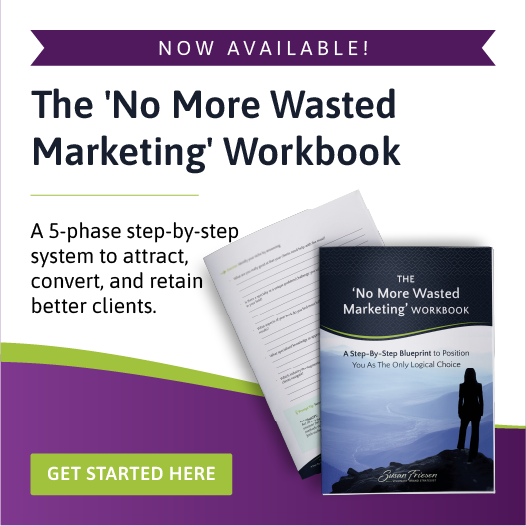
And that’s exactly what you’ll get in The ‘No More Wasted Marketing’ Workbook, a step-by-step guide to help you refine your brand positioning and uncover what makes your business stand out.
This isn’t just a workbook. It’s your roadmap to:
- Marketing that finally feels like it's working
- Offers that feel like a perfect fit (because they are)
- Magnetic messaging that speaks to your ideal client
- A brand that builds trust and authority at first glance
So, if you’re tired of attracting the wrong clients, or none at all, it’s time to change that.
Download The ‘No More Wasted Marketing’ Workbook Now and start building the kind of brand that your best clients just can’t ignore.

About the Author, Susan Friesen
Located in the lower mainland of B.C., Susan Friesen is a visionary brand strategist, entrepreneur, and founder of British Columbia’s premiere boutique web development and digital marketing agency, eVision Media.
With over 20 years of experience in the industry, she is an expert in helping businesses establish their online presence and create a strong brand identity.
Her passion for empowering entrepreneurs and small business owners to succeed in the digital world has earned her a reputation as a leading authority in the branding and marketing industry.
Visit www.BrandIdentitySteps.com and download your FREE guide: "Unlocking Customer Trust and Business Growth: Your 7-Step Guide to Defining a Compelling Brand Identity that Appeals to Your Perfect Clients".