
Why am I avoiding rebuilding my website, even though I know I need to?
If your website has been on your list for months, maybe years, you’re not alone.
Most service-based small business owners aren’t avoiding it because they don’t care.
They’re avoiding it because it feels like a massive, messy project that will steal time they don’t have.
And while you wait, your website can quietly cost you trust, inquiries, and sales.
If you’ve been putting off a website rebuild, it’s usually for one of three reasons.
Either it feels overwhelming, you’re worried you’ll hire the wrong person, or you don’t want a project that drags on and drains you.
But the problem is that waiting rarely makes it easier. It usually makes it urgent.
And urgency leads to rushed decisions, higher costs, and more stress.
Key Takeaways:
- People decide quickly whether they trust a business website.
- Website procrastination is often about overwhelm, not laziness.
- You don’t need to do every task yourself. You need a plan and a guide.
- An outdated or cluttered site can lower trust and reduce inquiries without you realizing it.
- A calm, guided website rebuild is possible, and it usually starts with a short conversation.
- AI is changing how people search, which makes your online credibility signals matter even more.
What I noticed in myself this week
This week, I’m in the middle of conducting interviews for a new graphic designer for our team.
And I’ll be honest. I procrastinated on this for much longer than I should have.
It wasn’t because it didn’t matter. It mattered a lot.
I kept putting it off because it felt like a lot.
I didn’t just need someone who can do graphic design. I needed someone detail-oriented and reliable.
Someone who can live up to our standards, someone who fits in well with our team, and someone who shares our values.
And then there was the risk.
What if I invest the time to bring someone on, and it’s not the right fit?
What if I train them, and they move on to a better offer?
So I kept pushing it down the list, until it became urgent. And the stress piled up.
That’s when I realized something.
This is exactly what so many business owners do with their website.
Why website rebuilds feel overwhelming
If you’ve been avoiding your website, your mind is probably doing the same thing mine did.
It runs through every detail all at once.
Pages to write, photos to take, tech decisions, logins, design choices, a dozen small tasks you don’t have time to think about.
So, you tell yourself you’ll deal with it later.
Here’s the part I want you to remember.
You don’t have to do it all yourself. You’re not supposed to.
A website rebuild should not feel like you’re building the whole thing alone while running your business.
It should feel guided, structured, supported.
6 reasons why you’ve put your website on the back burner
1) It feels like too many decisions at once
It’s less about the work and more about the mental load of deciding everything.
2) You’re worried you’ll hire the wrong person
You’ve seen what happens when people overpromise and underdeliver, and you don’t want to waste money and time.
3) You’re picturing a project that never ends
You’re afraid it will drag on for months and distract you from your real work.
4) Your website feels “fine enough”
It loads, it’s there, and you can send the link. So, it stays low on the list.
5) You don’t realize what it’s really costing you
You can’t see the leads you never got. You only feel the flat results later.
6) You’re trying to do too much of it alone
This is the big one. When you think it all falls on you, it becomes easy to avoid.
What it costs when your website sits too long
People make fast judgments when they land on a website.
They quickly scan and then decide whether they feel comfortable taking the next step.
Trust is the real issue here.
If your site feels outdated, cluttered, or hard to use, trust drops.
And when trust drops, people don’t respond.
They don’t book. They don’t buy. They move on, and you never know it happened.
Why this matters even more with AI
AI is changing how people search and compare options.
People are getting quick answers and moving around the internet faster.
So, when they do land on your website, it has to do its job quickly.
It needs to make it easy to understand:
- What you do
- Who you help
- Why you’re a safe choice
- What they should do next
Your website is often the first place someone goes to decide if they trust you.
That’s even more true when people are making decisions with less patience.
Gut-check: Is your website quietly holding you back?
- Do you avoid major updates because it feels like a pain and you don’t know where to start?
- Has it gotten cluttered because you kept adding things over the years?
- Do you feel embarrassed to share your website link?
- Have you ever said, “Ignore the site, it’s old”?
- Does it look bad on a phone?
If any of those hit, you’re not alone.
And this is fixable.
What to do next
Start small.
You don’t need to rebuild your entire website in your head today.
You need to get grounded in what matters most.
Here are a few practical next steps:
1) Decide what your website must do first
Most service-based businesses need their website to:
- Build trust quickly
- Make it easy to book or contact you
- Explain the core offer in plain language
2) Identify what’s actually outdated or cluttered
This is often the fastest win.
Remove what distracts, simplify what confuses.
3) Get help with the process
A guided plan removes the overwhelm.
It keeps the work realistic. And it stops the project from dragging on.
4) Put a date on the decision
If you keep it as “some day”, it stays “some day”. So, choose a date to start the conversation.
If your website has been on the backburner for too long, let’s talk.
Book a free consultation with me and we’ll look at what’s working, what’s not, and what your best next step is.
No pressure. Just relief that you have help with the details you’ve been carrying around.
Until next time, I’m Susan Friesen, your small business brand positioning strategist, inviting you to stay clear, stay focused, and stand out.
Ready to Attract Better Clients Without Working Harder?

You don’t need another crash course in funnels or hacks. You need clarity.
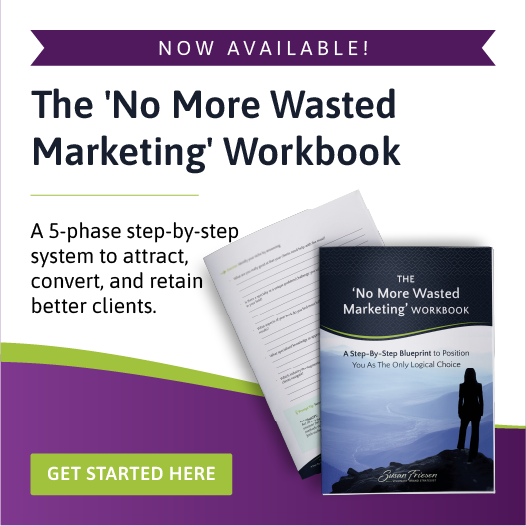
And that’s exactly what you’ll get in The ‘No More Wasted Marketing’ Workbook, a step-by-step guide to help you refine your brand positioning and uncover what makes your business stand out.
This isn’t just a workbook. It’s your roadmap to:
- Marketing that finally feels like it's working
- Offers that feel like a perfect fit (because they are)
- Magnetic messaging that speaks to your ideal client
- A brand that builds trust and authority at first glance
So, if you’re tired of attracting the wrong clients, or none at all, it’s time to change that.
Download The ‘No More Wasted Marketing’ Workbook Now and start building the kind of brand that your best clients just can’t ignore.

About the Author, Susan Friesen
Located in the lower mainland of B.C., Susan Friesen is a visionary brand strategist, entrepreneur, and founder of British Columbia’s premiere boutique web development and digital marketing agency, eVision Media.
With over 20 years of experience in the industry, she is an expert in helping businesses establish their online presence and create a strong brand identity.
Her passion for empowering entrepreneurs and small business owners to succeed in the digital world has earned her a reputation as a leading authority in the branding and marketing industry.
Visit www.BrandIdentitySteps.com and download your FREE guide: "Unlocking Customer Trust and Business Growth: Your 7-Step Guide to Defining a Compelling Brand Identity that Appeals to Your Perfect Clients".