How to keep trust, clarity, and control
Lately, my podcast queue has been full of big AI warnings.
Mo Gawdat says the next decade could erase many white-collar jobs and turn our systems upside down. And he’s not shy about timelines! He talks about how, in just a few years, this will happen, not someday.
Dr. Roman Yampolskiy paints an even starker picture: 99% of jobs will be gone, with just a handful left for humans, coupled with a real risk that super-intelligence will outrun us all.
Not to mention, they both firmly believe we will be experiencing life within a simulator any time now.
This stuff is hard to hear, but even harder to ignore.
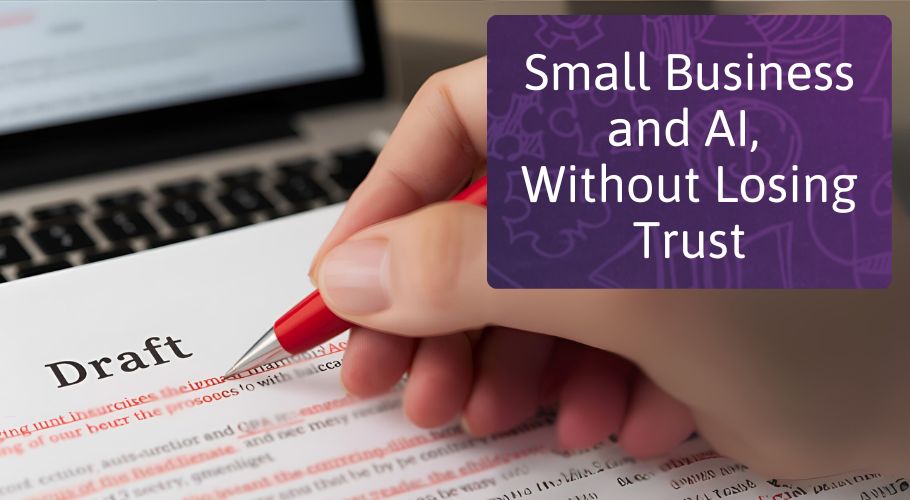
And then there’s me, in my office, crossing off my to-do list with a red pen, planning what I want 2026 to look like, and meeting with clients as usual. All the while, I’m using AI while secretly hoping nothing drastic will change because of its existence.
And in that gap between these incredulous predictions and a typical weekday morning, I am forced to wonder: Are we REALLY about to experience life in a simulation?
Are we already in one and aren’t aware of it?
Things that make you go hmm…
Part of me rolls my eyes at that thought, but the other part of me knows better.
Intellectually, I know we’re facing rapid change.
Faster than the internet.
Faster than smartphones.
In fact, I’ve been telling my team this for a couple of years. “We need to evolve and learn the tools to keep up, but most importantly, we need to combine our expertise along with these tools and not expect AI to replace that expertise.”
Case in point, last week I sat down with “Chaz” (yes, I’ve named my ChatGPT) to help with a promotion we’re doing in October. I asked it to act like an expert, and it gave me a decent first pass, but it agreed with me a little too much.
I found myself arguing with it:
- “Are you sure that would resonate with my audience?”
- “Knowing the type of entrepreneur who would benefit from this offering, shouldn’t we do this instead?”
- “What about this other perspective?”
The result? It praised my “excellent thinking”, which made me laugh.
Don’t get me wrong, a little flattery can make one feel good about oneself, but in this moment, I didn’t need flattery; I needed a strategic partner.
“Be an intellectual marketing sparring partner,” I told it, “not an agreeable assistant.”
We went back and forth, and the strategic plan slowly got better. But at the end of the day, it still needed me.
It needed my perspective, my judgment, my expertise and understanding of whom I serve.
AI simply can’t replace that – the culmination of my 20+ years of experience working with hundreds of entrepreneurs, small business owners, and non-profit executives.
So it seems I’m holding two truths at once:
- The future might unfold in ways none of us can fathom.
- The people I work with still need clarity, trust, and results – today, not when AI can indeed replace us all (but by then, there may not be a need for a business, who knows!)
So, for the present day, what does that mean for a small business owner?
For me, it comes down to agency.
I can’t control whether AGI (Agentic Artificial Intelligence) is a reality next year or in 2037. But I can control how I show up this week. I can control what I feed the AI tools available to me.
I can choose the standards I hold for my brand and my team and determine how and where AI fits into our day-to-day operations.
Here’s what I’m focusing on right now in hopes it will help you, too:
- I use AI like a smart assistant. It helps with creating drafts, but a human will always edit from there. The intention is to move faster, not sloppier.
- I lead everything I do with brand clarity. If my AI inputs are not clear, then the outputs will be generic and useless.
- I guard our brand voice carefully. We keep a living document of our voice tone, phrases I use often, and include words I would never use.
- I keep my team in the loop on strategy, staying in alignment with our brand ethics and ensuring we are living up to our promise.
You might be wondering if I worry about those big what ifs? Absolutely.
Some days, I wonder if my new book, which I’m planning to launch in 2026, will still be relevant in a world that looks very different from today.
Some days I wonder if we’ll look back and say, “Wow, we sure missed seeing that coming.”
And other days I’m reminded that shock and hype both sell, and the truth tends to sit somewhere in the middle.
Here’s the “middle” I’m living in:
- Panic doesn’t build a brand.
- Hype doesn’t keep clients.
- Consistency and trust will always win.
And don’t worry – if you’ve barely touched AI, you’re not too far behind. Just start small by giving it a clear directive of what you need help with. Ask it for three options, then pick one and improve it.
That’s all there is to it. You’re learning while you’re doing, and you’re not handing your expertise, history, and lived experience to an AI model, just using it to enhance what’s already there inside you.
And if you’re further along, ask more of it. Don’t let it flatter you; instead, ask it to challenge you. Ask it to show its work, prove its hypothesis, and detail its sources. Make it earn its worth!
That’s how I’m using AI, by staying curious, yet cautious, and always human-led.
Now I’d love your take.
Where do you draw the line with AI—what stays human, no matter what?
Until next time, I’m Susan Friesen, your small business brand positioning strategist, inviting you to stay clear, stay focused, and stand out.
It’s Time to Change Your Game

If you’ve spent too long feeling trapped in price wars, it’s time to make a change. Your expertise deserves better, and your clients need you to show them why you're worth the investment.
That’s exactly why I created The No More Wasted Marketing Workbook.
It provides a structured, step-by-step blueprint to help you clearly position your business as the obvious choice for your ideal clients. Inside the workbook, you’ll:
- Clarify your USP so clients easily recognize your value
- Craft your compelling brand story to build emotional connections
- Learn how to niche down effectively, positioning yourself as a specialist
- Develop content strategies that establish you as an authority and attract high-value clients
So, are you ready to stop competing on price and start attracting clients who truly value your expertise?
It's time to leave price wars behind and step confidently into your true worth.
Download The ‘No More Wasted Marketing’ Workbook Now and make the change needed to get the leads and sales your business needs.

About the Author, Susan Friesen
Located in the lower mainland of B.C., Susan Friesen is a visionary brand strategist, entrepreneur, and founder of British Columbia’s premiere boutique web development and digital marketing agency, eVision Media.
With over 20 years of experience in the industry, she is an expert in helping businesses establish their online presence and create a strong brand identity.
Her passion for empowering entrepreneurs and small business owners to succeed in the digital world has earned her a reputation as a leading authority in the branding and marketing industry.
Visit www.BrandIdentitySteps.com and download your FREE guide: "Unlocking Customer Trust and Business Growth: Your 7-Step Guide to Defining a Compelling Brand Identity that Appeals to Your Perfect Clients".