Have you ever wondered what happens when you become known for being an expert in a particular niche, and then decide to change what you offer?
Could that change adversely affect the very reason people love what you do in the first place?
This past weekend, Daniel and I went to see Pentatonix perform in Vancouver, and to say I was excited about it was an understatement.
They’ve been on my bucket list for years, so when I heard they were finally coming back to Vancouver with their Christmas in the City tour, I jumped at the chance to see them live in concert.
And they certainly didn’t disappoint.
Don’t worry, this video is not a review of their concert! What I want to explore with you today is a change they made last year that could have really hurt their brand.
Hi, I’m Susan Friesen, a small business brand positioning strategist, founder of eVision Media, and creator of The Position Strong Method.
Welcome to another episode of Stand Out & Thrive, where I share insights to help you build a business that people understand, trust, and want to work with.
If you’re new here, I invite you to subscribe to my channel for more practical advice on brand positioning and small business marketing.
But first, I want to take you back to when I was in high school.
I sang in the choir and performed in musical theatre. I even won an award for Best Vocal Jazz Singer in Grade 12!
So I’ve always had a special appreciation for vocal music, particularly a cappella.
I know firsthand how much skill it takes to blend voices, hold your own part while someone beside you is singing something completely different, and bring all those harmonies together.
And Pentatonix goes far beyond anything we tackled in high school!
If you’re not familiar with them, they’re a five-member vocal group that became famous for their a cappella arrangements. They create an incredible range of sounds using just their voices and have become particularly well known for their Christmas music.
When I first heard them, I was mesmerized by the quality of their singing, the range of their voices, and the arrangements they create.
The thing is, I didn’t fall in love with Pentatonix because they sounded like everyone else. I fell in love with them because they didn’t.
Which is why I had a bit of a reaction when they decided to change their sound.
In 2025, Pentatonix released their Christmas in the City album.
But they did something different.
Instead of relying entirely on their signature a cappella sound, they introduced orchestral and big-band arrangements into much of the music.
Now, I have nothing against orchestras. I love a beautiful orchestral arrangement.
But my first reaction was, “Wait a minute. Where’s the Pentatonix sound I love?”
Suddenly, there were all these instruments accompanying their voices.
And I wondered why a group known for doing something so distinctive would want to sound more like a traditional Christmas recording.
I also wasn’t particularly drawn to their choice of older, 1950s-style Christmas music. That was another departure from the arrangements I was used to hearing from them.
But I must say, I think they managed the change brilliantly.
Pentatonix actually talked about why they wanted to try this direction.
Scott Hoying explained that they had explored so much Christmas music over the years, but hadn’t really worked with the classic big-band and orchestral sound associated with artists like Dean Martin.
They wanted to explore that musical style and see what they could do with it.
They also made it clear they weren’t abandoning a cappella.
They were experimenting with another way to express their musical creativity.
Interestingly, by the time Daniel and I attended their concert, I’d listened to the Christmas in the City songs many times over last year’s holiday season.
So hearing those orchestral arrangements live didn’t feel strange anymore. I’d become familiar with them.
And watching them perform reminded me why I’m such a fan.
Those voices.
The harmonies.
The arrangements.
They were still very much Pentatonix.
Now, think about your own business for a moment.
What have your clients come to know you for?
Maybe you’re a consultant who’s built a reputation for working closely with clients one-on-one.
Then you decide to introduce a virtual membership where people can access your guidance at a lower price.
Or perhaps you’re a wellness practitioner who’s become known for a particular type of treatment and wants to expand into other services.
Your interests can change. Your experience grows. And your clients’ needs may change, too.
Sometimes that expansion makes very good business sense.
But there’s something I think business owners can overlook when they’re excited about a new direction.
You’re looking at the opportunity from the perspective of what it could mean for your business.
But what will your existing clients think when they see the change? Will they recognize the same value they’ve come to expect from you?
Let’s go back to that consultant for a moment.
Imagine that clients choose her because they value the individual attention, personal guidance, and ability to work through their particular challenges with her.
Then she introduces that virtual membership.
Some clients might love the option. It could be more affordable and give them access to her expertise in a different way.
Others might wonder whether she’s moving away from the personalized work that made them choose her in the first place.
The question for the consultant then becomes whether the membership still delivers the qualities people associate with her business, even if the format is different.
And whether she’s helping people understand why she’s introducing it.
Think about how differently Pentatonix fans might have reacted if the group had simply changed their sound without explaining why.
By sharing what inspired them, they gave their fans a chance to understand and become familiar with the new direction.
That doesn’t mean everyone liked it. I still prefer many of their original arrangements myself.
But I could understand what they were trying to do.
And that’s something I don’t see enough business owners doing when they introduce new offerings.
One day they’re known for a particular service, and suddenly their social media posts are promoting something quite different.
What prompted the change? How does it connect to their existing expertise? Is their original service still available?
The business owner knows the answers.
But their followers may not.
And that’s where confusion can begin.
I do want to make an important distinction here.
Explaining a change helps people understand it, but it doesn’t automatically make the change a good business decision.
You still need to consider whether what you’re introducing makes sense for the reputation you’ve built and the clients you want to attract.
This is something I discuss in Chapter 17 of my book, Position Strong.
I explore how easy it can be for business owners to get caught up in new opportunities, especially when there’s potential to generate more revenue.
A new opportunity comes up that looks promising. Clients are asking about it, and you notice competitors are offering it.
So you decide to add it to your business.
But have you considered what it might be doing to your overall positioning?
If you keep adding services that don’t have a clear connection to what you want to be known for, you can gradually change how people perceive your business.
You may even find that you’re attracting a different type of client than the people you originally set out to serve.
That’s why I believe these decisions deserve more consideration than simply determining whether there’s a market for the new offering.
You need to think about how it fits with your existing expertise, the experience you want to provide, and the reputation you’ve worked hard to establish.
When I look at Pentatonix, I see a group of exceptionally talented musicians exploring another musical style.
They didn’t suddenly decide to become something completely unrelated to their talents.
Their voices and arrangements remained central to the music.
The presentation changed, and not every fan loved it.
Still, there was a clear creative connection to what they were already known for.
And that’s the distinction I’d encourage you to think about in your own business.
What do they currently value most about working with you?
Will your new offering build on that experience, or change something they’ve come to rely on?
And have you explained why you’re making the change and what it means for them?
I’m certainly not suggesting you keep your business exactly the same forever. That wouldn’t make much sense.
But I do think you need to understand what you’ve become known for before making changes that could affect that reputation.
Pentatonix reminded me of that.
I may not love every musical direction they choose, but I still recognize the talent and qualities that made me a fan.
And that’s the position I’d want you to protect in your own business.
Because adding something new isn’t automatically going to make your business more appealing.
Sometimes it does.
Other times, it leaves people wondering what happened to the business they originally chose.
If you’re not entirely sure what your business is currently communicating to potential clients, I invite you to take my free Position Strong Brand Audit.
It will help you look at your business from an outside perspective and identify areas where your positioning and messaging may need some adjusting.
You can find it at PositionStrongBrandAudit.com. I’ll also include the link below this video.
And I’d love to hear what you think.
Have you ever been disappointed when a business or brand you loved changed something that made it special?
Let me know in the comments.
Until next time, I’m Susan Friesen, your small business brand positioning strategist, inviting you to stay clear, stay focused, and stand out.
Ready to Attract Better Clients Without Working Harder?

You don’t need another crash course in funnels or hacks. You need clarity.
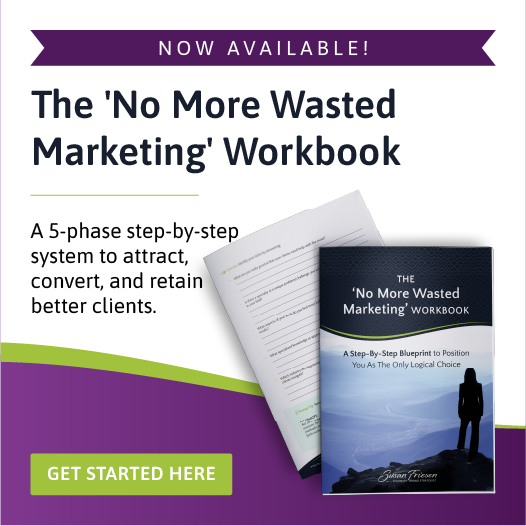
And that’s exactly what you’ll get in The ‘No More Wasted Marketing’ Workbook, a step-by-step guide to help you refine your brand positioning and uncover what makes your business stand out.
This isn’t just a workbook. It’s your roadmap to:
- Marketing that finally feels like it's working
- Offers that feel like a perfect fit (because they are)
- Magnetic messaging that speaks to your ideal client
- A brand that builds trust and authority at first glance
So, if you’re tired of attracting the wrong clients, or none at all, it’s time to change that.
Download The ‘No More Wasted Marketing’ Workbook Now and start building the kind of brand that your best clients just can’t ignore.

About the Author, Susan Friesen
Located in the lower mainland of B.C., Susan Friesen is a visionary brand strategist, entrepreneur, and founder of British Columbia’s premiere boutique web development and digital marketing agency, eVision Media.
With over 20 years of experience in the industry, she is an expert in helping businesses establish their online presence and create a strong brand identity.
Her passion for empowering entrepreneurs and small business owners to succeed in the digital world has earned her a reputation as a leading authority in the branding and marketing industry.
Visit www.BrandIdentitySteps.com and download your FREE guide: "Unlocking Customer Trust and Business Growth: Your 7-Step Guide to Defining a Compelling Brand Identity that Appeals to Your Perfect Clients".