
What Makes a Content Marketing Plan Effective Today?
In today’s world, an effective content marketing plan is built on clarity, not volume.
In an AI-driven environment where content is easy to create and everywhere all at once, what matters most is whether your content clearly communicates who you help, what you stand for, and why your perspective can be trusted. Without that clarity, content tends to blend in, sound generic, or fail to support real business goals.
A strong content marketing plan aligns content with brand positioning first, then uses AI as a support tool to maintain consistency and efficiency.
Key Takeaways:
- Trust and authority matter more than volume or reach
- Content needs a defined purpose tied to business goals
- Consistency and focus drive better results than trend chasing
- An effective content marketing plan starts with clear brand positioning
- AI should support consistency and efficiency, not replace strategy or voice
Content marketing has changed significantly over the years, and what once worked well no longer guarantees results.
Publishing more content, showing up on every platform, or reacting to every new tactic often leads to burnout instead of growth.
So, today, the challenge is not about creating content.
The challenge is figuring out how to be clear, credible, and recognizable in a marketplace that’s flooded with information.
AI has accelerated content creation at a pace we’ve never seen before, and that speed can be incredibly helpful.
But it can also quietly work against you if your content marketing plan lacks direction.
A modern content marketing plan is no longer about doing more. It’s about doing the right things, in the right order, for the right reasons.
And in addition to creating a plan, if you want your content marketing to be effective, you need to stay ahead of the trends before you start eating your competitors’ dust.
With that in mind, this article explores four current content marketing trends shaping how businesses attract and convert clients today, followed by a guide to building a content marketing plan that protects your positioning, strengthens trust, and uses AI responsibly.
Trend #1: Brand Positioning Is No Longer Optional
One of the most important shifts in content marketing is the growing role of brand positioning.
Audiences are overwhelmed, and as a result, they’re scanning, filtering, and making snap judgments faster than ever.
What this means is that if your content does not quickly communicate whom you help and why you matter, it’s going to get ignored.
But brand positioning is what gives your content meaning.
It answers the questions your audience is already asking, often subconsciously, like:
- Do I trust this perspective?
- Is this for someone like me?
- Do they understand my problem?
- Do they sound credible and confident?
What’s more, without clear positioning, content tends to drift. One week it sounds educational, the next week it sounds promotional, and the next week it borrows language from competitors or trends that don’t quite fit.
And the result is confusion.
On the other hand, a strong content marketing plan anchors every piece of content back to a clear position, and it ensures your message sounds like you, no matter the format or platform.
Trend #2: AI Is Changing Content Creation, Not Content Strategy
AI has changed how quickly content can be produced, but it has not changed what makes content effective.
And that distinction matters.
Many business owners are using AI to generate articles, posts, and emails without first defining their voice, message, or positioning.
The output may look polished, but it often feels generic, and your audience will notice.
They may not point to AI directly, but they’ll sense when your content lacks depth, conviction, or originality, and this quietly erodes trust.
In any case, AI works best when it supports an existing strategy, not when it replaces one.
In a strong content marketing plan, AI is used intentionally:
- To support idea generation
- To help maintain structure and consistency
- To repurpose long-form content into multiple formats
- To speed up drafts that are later refined by a human voice
AI should never be responsible for deciding what you stand for or how you show up. That work belongs to you.
Trend #3: Trust and Authority Drive Conversions More Than Visibility
Visibility alone is no longer enough.
You can have thousands of followers, but still struggle to convert interest into inquiries.
What makes the difference is trust, and that’s built over time through things like consistency, clarity, and relevance.
At any rate, authority is not about being everywhere. It’s about being known for something specific and communicating it clearly.
A content marketing plan that prioritizes trust focuses on:
- Offering clarity rather than hype
- Educating rather than impressing
- Speaking directly to real problems
- Showing up consistently with the same message
This kind of content may grow more slowly, but it compounds, as it supports referrals, shortens sales cycles, and helps you attract better-fit clients.
Trend #4: Consistency and Focus Beat Volume
Publishing constant content without direction often leads to burnout and frustration.
But consistency doesn’t mean constant output. It just means showing up in a way your audience can recognize and rely on.
Consistency shows up in:
- Your tone
- Your messaging
- Your point of view
- The problems you repeatedly address
In any case, a well-designed content marketing plan chooses sustainability over pressure, and it’s built around what you can realistically maintain while still running your business.

A strong content marketing plan works best when it connects emotionally, not just intellectually.
With that in mind, this article explores how clear brand storytelling builds trust, helps people feel understood, and influences why they choose one business over another.
This is incredibly important, as content that’s rooted in this kind of clear storytelling tends to resonate more deeply, while strengthening authority, and supporting the clarity and consistency your content marketing plan depends on.
How to Build a Content Marketing Plan That Works in the Age of AI
This is where most business owners struggle.
They jump straight into content ideas without building a foundation first, and that leads to scattered messaging, inconsistent results, and the feeling that content marketing does not work.
A strong content marketing plan follows a clear sequence, like the one I’ve laid out below.
Step 1: Clarify Your Brand Positioning First
Before you plan a single piece of content, you need clarity.
This includes:
- Whom you serve
- The outcomes you’re known for
- The core problems you help solve
- What makes your approach different
Without this clarity, content becomes guesswork.
You may publish helpful information, but it’s not likely to stick, as it doesn’t reinforce a clear message in the minds of your audience.
Moreover, your content marketing plan should reflect a single, recognizable brand position, as repetition builds trust and consistency builds authority.
Step 2: Define the Purpose of Your Content
Not all content serves the same role.
A common mistake is expecting every post or article to generate leads immediately, which creates pressure and disappointment.
Instead, you should decide what role your content marketing plan is meant to play.
Content can be used to:
- Nurture relationships over time
- Educate and build understanding
- Establish credibility and authority
- Support referrals and word of mouth
- Address objections before sales conversations
And when each piece of content has a clear purpose, your plan becomes easier to execute and much easier to measure.
Step 3: Choose Channels With Intention
Being on every platform rarely works well.
So, make sure to choose channels based on:
- What formats feel natural to you
- How content supports your broader strategy
- Where your audience already pays attention
For many service-based businesses, a strong blog combined with email and one primary social media platform creates more traction than scattered efforts across every single platform.
Your content marketing plan should reduce noise, not add to it.
Step 4: Create Clear Content Pillars
Content pillars give your plan structure.
They help you stay focused and prevent the constant question of “What should I post next?”
Ideally, your content pillars should be aligned with your brand positioning and expertise, and this may include:
- Clarifying misconceptions in your industry
- Real-world observations or lessons learned
- Educational insights tied to your core services
- Perspective-based content that reflects your values
These pillars guide both human-created and AI-supported content, and they also act as guardrails that protect the consistency of everything you create.
Step 5: Integrate AI With Boundaries
AI should never be a shortcut around clarity.
And in an effective content marketing plan, AI is used within clear boundaries:
- Your strategy should be led by humans
- Every output should be reviewed and refined
- Your voice, tone, and language need to remain intact
- AI should be used to support drafting, not final messaging
All things considered, AI should save you time, but saving time should not take priority over the quality of your content or trust between you and your audience.
Why Content Marketing Plans Fail
When content marketing feels exhausting or ineffective, the issue is rarely effort.
But if you’re wondering why content marketing plans fail, the truth is it’s usually due to a lack of alignment.
Common reasons why they fail include:
- Chasing trends without a strategy
- A lack of clear brand positioning
- Overreliance on automation
- Unrealistic expectations
- Inconsistent messaging
But a content marketing plan that’s rooted in brand clarity works differently.
It builds trust over time, attracts better-fit clients, and supports your growth instead of draining your energy.
So, before you create more content, make sure it’s aligned.
Because when you start with that kind of clarity, your content will work harder for you.
Ready to Strengthen Your Content Marketing Plan?
If you’re creating content consistently but still feel unclear about your messaging, positioning, or direction, this is exactly what my Brand Clarity and Gap Audit is designed to uncover.
It’ll help you:
- Identify where your messaging is working against you
- Clarify your positioning before you create more content
- Spot gaps between your expertise and how it is perceived
- Build a stronger foundation for your content marketing plan
To your business success,
Susan Friesen
P.S. If you liked the article, you might want to subscribe to our newsletter. We publish tons of valuable content to help you learn more about marketing, and subscribing is the best way to ensure you don’t miss out. Additionally, if you’d like to learn more about building a search engine optimized website, click here for our free website guide.
Ready to Attract Better Clients Without Working Harder?

You don’t need another crash course in funnels or hacks. You need clarity.
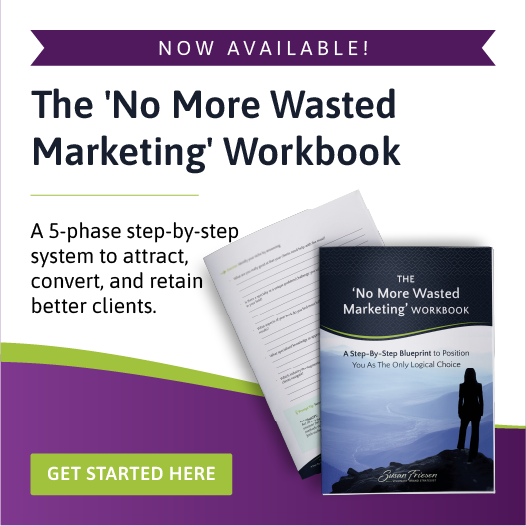
And that’s exactly what you’ll get in The ‘No More Wasted Marketing’ Workbook, a step-by-step guide to help you refine your brand positioning and uncover what makes your business stand out.
This isn’t just a workbook. It’s your roadmap to:
- Marketing that finally feels like it's working
- Offers that feel like a perfect fit (because they are)
- Magnetic messaging that speaks to your ideal client
- A brand that builds trust and authority at first glance
So, if you’re tired of attracting the wrong clients, or none at all, it’s time to change that.
Download The ‘No More Wasted Marketing’ Workbook Now and start building the kind of brand that your best clients just can’t ignore.

About the Author, Susan Friesen
Located in the lower mainland of B.C., Susan Friesen is a visionary brand strategist, entrepreneur, and founder of British Columbia’s premiere boutique web development and digital marketing agency, eVision Media.
With over 20 years of experience in the industry, she is an expert in helping businesses establish their online presence and create a strong brand identity.
Her passion for empowering entrepreneurs and small business owners to succeed in the digital world has earned her a reputation as a leading authority in the branding and marketing industry.
Visit www.BrandIdentitySteps.com and download your FREE guide: "Unlocking Customer Trust and Business Growth: Your 7-Step Guide to Defining a Compelling Brand Identity that Appeals to Your Perfect Clients".