How Do I Choose the Right Marketing Channels for My Business?
Choosing the right marketing channels starts with understanding where your ideal clients look for services like yours and how they make their purchasing decisions.
You should consider which channels are already attracting qualified prospects, what each channel contributes to your marketing strategy, and whether the results justify the time and money you’re spending on each one.
The goal is to focus your resources on activities that help you reach the right people and support your business goals.
Key Takeaways:
- Choose channels based on your ideal clients’ behaviour, rather than popularity.
- Measure meaningful results, especially the quality of inquiries you’re receiving.
- Understand the role each channel plays in attracting and converting clients.
- Consider the true cost of maintaining each channel, including your time.
- Regularly assess which channels to keep, improve, test, or discontinue.
From the outside, your marketing looks pretty active with all of the activity that you do.
But when you look at the clients who actually contact you, can you tell which of those efforts made a difference?
Or are you investing in a collection of marketing activities simply because they’ve become part of your routine?
Perhaps one platform gets plenty of likes but very few serious inquiries. Meanwhile, another one barely gets your attention, but some of your best clients mention finding you there.
These are the kinds of things that’ll make you wonder whether you’re putting your resources in the right places.
In any case, where your ideal clients go for information, how they evaluate their options, and what helps them feel confident enough to reach out should all influence your marketing decisions.
And that’s why knowing how to choose marketing channels requires looking beyond what’s popular or getting the most attention.
You need to understand which activities genuinely support your business goals and whether the results justify the resources you’re putting into them.
So, before you commit another dollar or hour to your marketing, consider this: Which of your current activities are helping you attract the clients you want, and which ones have you simply never stopped doing?
Why Using More Marketing Channels Doesn’t Guarantee Better Results
Marketing activities have a way of accumulating.
You open a Facebook page because everyone seems to have one, you start using LinkedIn because your colleagues are using it, and you begin publishing articles, try a few ads, and commit to a newsletter because staying in touch with your contacts makes sense.
Each decision may have made sense at the time when you made it.
But have you assessed what each channel is contributing now?
I often see business owners judging their marketing based on how much they’re doing.
Their calendar is full and posts are going out, but the inquiries coming in haven’t changed much, or they’re still hearing from people who aren’t a good fit.
So, before adding another channel, you’re going to want to ask what it’s there to accomplish.
And if you can’t explain its purpose, then at the very least, it deserves a closer look.
How to Choose Marketing Channels Based on Your Ideal Clients
Even when you’ve clearly defined your ideal clients, it’s easy to make assumptions about where to reach them.
You may understand their needs, challenges, and what they value in a service provider, but still not know where they turn when they’re ready to find someone with your expertise.
This is an important distinction because a marketing channel can reach plenty of the right people without necessarily influencing their decision to contact you.
With that in mind, if you want to make a more informed choice, you should look at how your ideal clients actually search for services and what you can learn from the people who have already chosen to work with you.
Understand Where Your Ideal Clients Look for Information
Someone seeking a financial advisor might enjoy scrolling through Instagram every evening, but ask a colleague for a referral or search Google when they need professional advice.
The truth is where people spend their free time and where they make buying decisions aren’t necessarily the same places.
Think about what actually prompts your ideal client to start looking, what questions they have, and where they might go to find answers.
Do they search for a specific service? Ask their professional network? Attend industry events? Follow experts whose opinions they trust?
Whatever the case, those behaviours offer clues about where your business needs to appear.
Look at How Your Best Clients Found You
Your existing client relationships can tell you a great deal.
Think about your last ten good-fit clients, and ask yourself:
- Where did they first hear about me?
- What did they look at before reaching out?
- Did they read my articles, visit my website after a referral, or follow me on LinkedIn?
And if you don’t know the answers to these questions, you should ask them when you’re onboarding new clients.
Because knowing how to choose marketing channels starts with paying attention to how clients actually find you, rather than assuming the most visible platform must be the most valuable one.
Read: Knowing Your Ideal Client Isn’t the Same as Understanding Them

You might have a clear picture of who your ideal clients are but still be making assumptions about what influences their decisions.
With that in mind, this article explores why understanding your audience needs to go beyond a basic client profile and how that deeper insight can change the way you communicate your value.
If you want to make more informed marketing decisions based on what actually matters to the people you’re trying to reach, then this is for you.
Understand What Each Marketing Channel Is Supposed to Accomplish
Different channels can do different jobs, and those jobs may happen at different points in a client’s decision-making process.
SEO and a Google Business Profile, where relevant, can help people find you when they’re researching services.
At the same time, social media can introduce your perspective and help people become familiar with your work, email gives you a way to stay connected with people who have already shown interest, and referrals, networking, and partnerships can introduce you through relationships that carry their own credibility.
What’s more, your website has an important role in all of this. It’s where a potential client can explore your services, see evidence of your experience, and decide whether your business feels like the right fit.
In any case, someone might notice an insightful LinkedIn post, look at your website a few days later, and then sign up for your newsletter. Then, three months after that, they book a consultation.
But which channel deserves the credit here?
These things are rarely as simple as one click leading to one sale.
So, when you’re assessing how to choose marketing channels, you should consider how they support one another, rather than expecting every channel to produce inquiries on its own.
Consider the True Cost of Maintaining Each Marketing Channel
The cost of maintaining a marketing channel includes more than just ads, software, or outside help.
Your time has value, too, whether you’re the one producing the content or managing the people who do.
A social platform may be free to join, but maintaining it could mean planning posts, creating graphics, recording videos, responding to comments, and reviewing results.
An email newsletter requires useful content, list management, and follow-up.
And even paid advertising needs attention to be paid to the message, landing page, and quality of the inquiries it generates.
However, if you spread your resources too thin, then promising channels may never get the attention they need.
For example, regular short-form videos might suit a business whose owner enjoys speaking on camera and has support for production. But they may be far less practical for a small business that’s already struggling to keep up with client work.
How to Evaluate Whether Your Marketing Channels Are Working
Once you’ve identified which marketing channels make sense for your business, you need to know whether they’re delivering enough value to justify your continued investment.
The challenge here is that marketing reports can give you plenty of numbers without telling you much about what’s actually contributing to your business.
One channel might generate impressive traffic or engagement while bringing in very few suitable prospects, while another might seem to produce modest results but play an important role in helping potential clients decide to contact you.
So, if you want to determine which marketing channels are working for your business, you need to look at the results that matter to your business, the quality of the people you’re attracting, and the patterns that emerge over time.
Measure Results That Matter to Your Business
One of the biggest mistakes you can make when evaluating your marketing channels is assuming that more activity means better results.
A social media post might receive hundreds of likes, or your website might attract thousands of visitors each month. And those numbers can look encouraging, but what are they actually telling you about the effectiveness of your marketing?
To get a more accurate picture, you need to consider what each channel is contributing to your business.
For example, if you’re investing in SEO, are more people finding your services through relevant searches and contacting you? And if you’re paying for Google Ads, how many of those clicks are turning into legitimate inquiries?
It’s also important to remember that some marketing activities are meant to build familiarity and trust over time, so their value won’t always show up as an immediate sale.
The important thing is to look beyond the numbers that make your marketing appear successful and objectively assess what each channel is actually contributing.
Consider the Quality of the Leads You’re Attracting
Suppose a campaign brings in twenty inquiries, but most of them are from people seeking a service you no longer offer or from those looking for the lowest possible price.
On the other hand, another channel brings in only four inquiries, but three come from people who understand your expertise and are a good fit.
Truth be told, the second channel may be doing much more for your business, even though its numbers look smaller.
And this is why evaluating the effectiveness of marketing channels should include the relevance of the audience, not simply the volume of attention.
Decide Which Marketing Channels to Focus On
At this point, you should take inventory of the marketing you’re currently doing.
For each activity, consider whom it reaches, the role it plays, what it costs to maintain, and what you know about its results.
Then use those answers to sort your channels into four practical categories:
- Keep. Continue investing in channels that reach the right people and serve a clear, valuable purpose.
- Improve. Adjust channels with potential that may be held back by unclear messaging, inconsistent execution, or a website that doesn’t make the next step easy.
- Test. Give promising new channels a defined goal, a modest commitment, and enough time to gather useful evidence before expanding.
- Reduce or stop. Free up resources from activities that consistently demand attention without contributing enough to justify it.
All things considered, you don’t need to appear everywhere to build a business that people recognize and trust.
You just need to show up where your ideal clients will notice you, with a message that helps them understand what you offer and why it matters.
The challenge is knowing which marketing activities are helping you accomplish that and which ones are taking up valuable resources without offering much in return.
And this is why regularly reviewing your marketing efforts is so important.
So, before committing to another marketing activity, make sure to take a closer look at what you’re already doing, consider what’s working, what could be improved, and where your resources might make a greater impact.
The goal is to make sure every dollar you invest in marketing has a clear purpose and supports the kind of business you’re working to build.
Is your marketing bringing you the right clients, or could your time and money be better spent elsewhere?
Book a free consultation and let’s look at your current marketing strategy, identify where you may be wasting valuable resources, and explore opportunities to attract more of the clients you actually want to work with.
To your business success,
Susan Friesen
P.S. If you liked the article, you might want to subscribe to our newsletter. We publish tons of valuable content to help you learn more about marketing, and subscribing is the best way to ensure you don’t miss out. Additionally, if you’d like to learn more about building a search engine optimized website, click here for our free website guide.
Ready to Attract Better Clients Without Working Harder?

You don’t need another crash course in funnels or hacks. You need clarity.
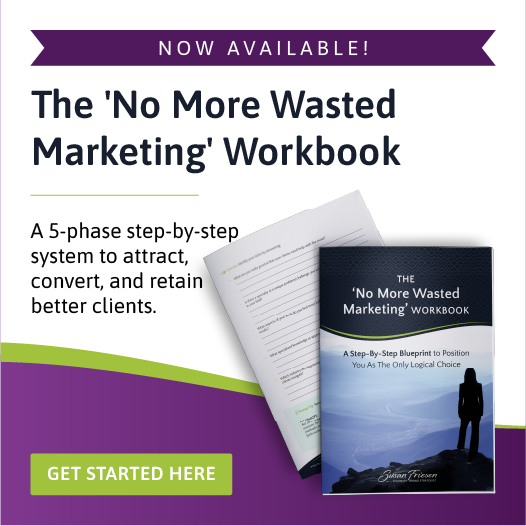
And that’s exactly what you’ll get in The ‘No More Wasted Marketing’ Workbook, a step-by-step guide to help you refine your brand positioning and uncover what makes your business stand out.
This isn’t just a workbook. It’s your roadmap to:
- Marketing that finally feels like it's working
- Offers that feel like a perfect fit (because they are)
- Magnetic messaging that speaks to your ideal client
- A brand that builds trust and authority at first glance
So, if you’re tired of attracting the wrong clients, or none at all, it’s time to change that.
Download The ‘No More Wasted Marketing’ Workbook Now and start building the kind of brand that your best clients just can’t ignore.

About the Author, Susan Friesen
Located in the lower mainland of B.C., Susan Friesen is a visionary brand strategist, entrepreneur, and founder of British Columbia’s premiere boutique web development and digital marketing agency, eVision Media.
With over 20 years of experience in the industry, she is an expert in helping businesses establish their online presence and create a strong brand identity.
Her passion for empowering entrepreneurs and small business owners to succeed in the digital world has earned her a reputation as a leading authority in the branding and marketing industry.
Visit www.BrandIdentitySteps.com and download your FREE guide: "Unlocking Customer Trust and Business Growth: Your 7-Step Guide to Defining a Compelling Brand Identity that Appeals to Your Perfect Clients".