
If you want your brand to stand out, then clear, compelling messaging is your secret weapon.
But as I’ve seen over the years, far too many business owners invest time and money in their brand positioning, only to struggle to try to translate that positioning into words that will truly connect with their ideal clients.
What’s more, they often make the mistake of assuming their messaging is the same thing as their marketing, but that couldn’t be further from the truth.
Marketing tactics like social media, Google ads, and newsletters are the kinds of vehicles you’ll use to carry your message.
But your messaging itself provides clarity around who you are, whom you serve, and why it matters.
It’s the heartbeat behind every interaction you have with your audience, and it’s how your ideal clients are going to be able to recognize that you’re the right fit.
Without messaging that matches your brand positioning, your marketing efforts will feel disjointed, confusing, and ineffective.
Your ideal clients won’t feel seen or understood, and they’ll quickly move on to someone who communicates more clearly.
So, if you want to ensure you’ve got messaging that matches your brand positioning, this article will tell you everything you need to know.
What’s the Difference Between Messaging and Marketing?
Your messaging should articulate your brand positioning in clear, relatable language. It’s the intentional expression of your brand’s value, personality, and differentiation.
Messaging also functions as your brand’s voice and personality, which helps to ensure consistency across every platform and interaction.
The term marketing, on the other hand, refers to a set of activities used to promote your message.
While marketing might involve running ads, creating content, or posting on social media, messaging is the narrative thread that consistently runs through all of these efforts, making your marketing more coherent and impactful.
Aligning your messaging with your brand positioning in this way ensures your audience will instantly understand the essence of your brand.
And this alignment helps to establish trust, clarity, and consistency, which are all essential elements of effective marketing and successful client relationships.
Creating Messaging That Matches Your Brand Positioning
Translating your brand positioning into powerful messaging doesn’t need to be overwhelming.
But if you want messaging that matches your brand positioning, you should start by revisiting your branding to gain some clarity.
Because even if you’ve already got a good handle on your positioning, taking stock of everything can help you refine things even further. In doing so, you should ask yourself these kinds of questions:
- Who am I?
- Whom do I serve?
- What problem(s) do I solve?
- Why should my clients care?
After you’ve gone through this exercise, the next step is to identify the kinds of emotions that drive your ideal clients.
It’s important to consider the frustrations and fears you alleviate and the aspirations or dreams you fulfill, as understanding these emotional motivators will allow you to craft messages that deeply resonate with your audience.
Then, after you’ve done all this, try choosing three to five core messaging themes based on your brand positioning and the emotional triggers of your ideal clients.
These themes might include things like clarity, simplicity, confidence, expertise, and trust.
But regardless of what themes you choose, every piece of messaging you create should be tied back to these foundational subjects.
Finally, you’ve got to figure out how to translate these insights into clear, client-friendly language, which means you should avoid jargon and overly technical terms.
Instead, try to speak directly to your clients’ experiences in language that’s easy to understand.
For example, instead of saying something like, “We leverage industry-leading methodologies,” what you should say is, “We simplify complex challenges, so you can stop worrying and start thriving.”
Read: Why Your Marketing Isn’t Working, And What to Fix First

It’s incredibly important to make sure you’ve got messaging that matches your brand positioning.
But if it feels like your marketing isn’t working, it could be more than just an alignment issue, and it might be your brand positioning itself that could use some work.
With that in mind, this article explains why brand positioning is so critical, explores common mistakes and how to avoid them, and offers practical advice to help you refine your brand positioning.
Key Places Where Your Messaging Needs to Be Seen
If you want to bring in a steady stream of clients, it’s not enough to just create messaging that matches your brand positioning.
You also need to make sure that messaging is featured in all the right places.
Below are some key places where your messaging should be prominently and consistently featured.
Home Page
The Home page on your website is often the first place potential clients will encounter your brand, and it’s arguably the most important place to put this messaging.
In any case, the verbiage you use on this page should clearly communicate whom you help, how you help them, and what sets you apart using concise headlines and subheadings.
For instance, the main heading on your Home page might say something like, “Offering Natural Strategies to Manage Perimenopause,” followed by a clear explanation of how you do that for clients.
About Page
Another important place to put this messaging is on your website’s About page.
Now, you might think an About page is just a boring biography of you and your business.
But the truth is, it’s an opportunity to share the story of your brand and what it can do for potential clients.
Your About page should communicate your core brand positioning and let potential customers know what you stand for.
Moreover, it should reflect on the emotional journey your clients will experience when working with you and highlight your approach to solving their challenges, as this can help to build rapport and trust by conveying confidence and empathy.
Social Media
Social media platforms are invaluable in this aspect, as they provide a litany of opportunities to make sure your messaging is being seen by your ideal clients.
Social media bios, for example, offer a great place to convey your message to potential customers.
However, they only provide limited space, so you’ll have to figure out how to condense your message down into as few words as possible.
Just make sure to clearly state your mission, whom you serve, and how you make a difference in these people’s lives.
For example, your bio could say something like, “You don’t have to push through the brain fog, bloating, and burnout anymore. I help women in perimenopause rebalance their hormones, reset their energy, and feel like themselves again.”
Lead Magnets
Lead magnets or any other freebies you offer provide amazing opportunities to showcase your expertise in a practical, immediate way.
But if you want to ensure their messaging lines up with your brand positioning, you should create offerings that focus on your core messaging themes.
If you already have a lead magnet in place, you might want to revisit it and make some changes to ensure its messaging matches your brand positioning.
Your lead magnet should be something that clearly reflects your positioning and directly solves a pressing need for potential clients.
How to Test and Tweak Your Messaging for Even Better Results
Regular evaluation, testing, and refinement will help you keep your messaging relevant, impactful, and aligned with your evolving brand positioning.
So, you should regularly monitor metrics like website analytics, email open rates, click-through rates, and social media interactions.
Then you can analyze that data to identify the elements of your messaging that resonate best with your audience.
Also, do what you can to get feedback from your existing clients, so you can use their language and insights to continuously refine and enhance your messaging.
You can try A/B testing, as well, by analyzing how various headlines, email subject lines, and calls to action perform to discover which variations work best.
Finally, you should make a point of scheduling regular messaging audits to review all your messaging and ensure it remains consistent with your brand positioning as it evolves.
Doing all this testing and tweaking can be a lot of work, but it’s totally worth it, as it will allow you to proactively identify any misalignment and find ways to improve your messaging.
Putting it All Together
Creating messaging that matches your brand positioning isn’t just about choosing the right words; it’s about consistently communicating your unique value to your ideal clients in a way that resonates deeply.
Because when your messaging authentically aligns with your brand positioning, your ideal clients will instantly recognize you as the perfect choice.
Your marketing will become simpler, more impactful, and more effective as you build trust, credibility, and a strong, memorable reputation.
This approach doesn’t just simplify your marketing; it transforms your entire business.
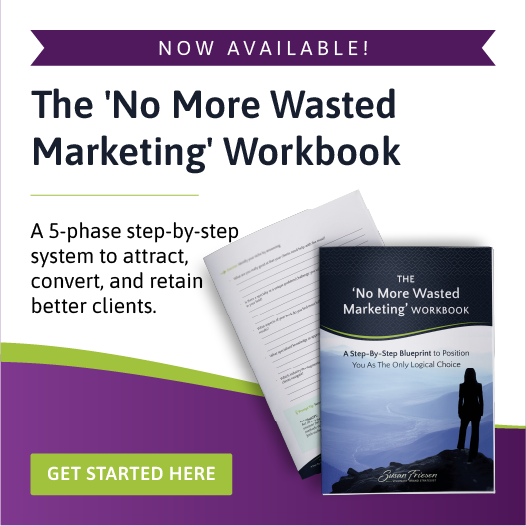
If you’re tired of sounding like everyone else, and you’re ready to start attracting clients who value what you do, The ‘No More Wasted Marketing’ Workbook will guide you step-by-step.
You can use it to uncover the gaps in your brand messaging, clarify your value, and start communicating with confidence across every platform.
Download your copy today and start creating messaging that works as hard as you do
To your business success,
Susan Friesen
P.S. If you liked the article, you might want to subscribe to our newsletter. We publish tons of valuable content to help you learn more about marketing, and subscribing is the best way to ensure you don’t miss out. Additionally, if you’d like to learn more about building a search engine optimized website, click here for our free website guide.
Ready to Attract Better Clients Without Working Harder?

You don’t need another crash course in funnels or hacks. You need clarity.
And that’s exactly what you’ll get in The ‘No More Wasted Marketing’ Workbook, a step-by-step guide to help you refine your brand positioning and uncover what makes your business stand out.
This isn’t just a workbook. It’s your roadmap to:
- Marketing that finally feels like it's working
- Offers that feel like a perfect fit (because they are)
- Magnetic messaging that speaks to your ideal client
- A brand that builds trust and authority at first glance
So, if you’re tired of attracting the wrong clients, or none at all, it’s time to change that.
Download The ‘No More Wasted Marketing’ Workbook Now and start building the kind of brand that your best clients just can’t ignore.

About the Author, Susan Friesen
Located in the lower mainland of B.C., Susan Friesen is a visionary brand strategist, entrepreneur, and founder of British Columbia’s premiere boutique web development and digital marketing agency, eVision Media.
With over 20 years of experience in the industry, she is an expert in helping businesses establish their online presence and create a strong brand identity.
Her passion for empowering entrepreneurs and small business owners to succeed in the digital world has earned her a reputation as a leading authority in the branding and marketing industry.
Visit www.BrandIdentitySteps.com and download your FREE guide: "Unlocking Customer Trust and Business Growth: Your 7-Step Guide to Defining a Compelling Brand Identity that Appeals to Your Perfect Clients".