
What’s the Risk of Reacting to Marketing Trends?
The biggest risk is that trends start driving your decisions instead of your strategy. That can create lots of motion, but not much progress.
When you keep adjusting your message or content to match what’s popular, people have a harder time understanding what you do and why they should choose you.
What’s more, trends can also give you misleading feedback, like engagement without consistent inquiries.
In any case, you should make use of trends only when they support what you’re already building, not as the foundation of your marketing.
Key Takeaways:
- Marketing trends can create activity, but activity doesn’t guarantee growth.
- Constant trend reaction causes message drift, making your business harder to understand.
- Trend-led marketing rarely compounds, so you keep resetting instead of building momentum.
- Platform performance can mislead you into optimizing for attention instead of buyer confidence.
- Asking yourself some tough questions before adopting any trend can help you ensure you’re headed in the right direction.
Many businesses don’t have a marketing problem; rather, it’s a direction problem.
And that’s what happens when marketing trends start driving your decisions.
You see a new platform, a new format, a new tool, or a new “must-do” tactic.
People you follow are talking about it, a competitor seems to be getting traction by using it, and then you try it because it feels smart to stay current.
To be fair, you might get a short burst of attention. But then it will inevitably fade.
At this point, you’re probably asking yourself, “Why is growing my business so unpredictable?”
But if you’re reacting to marketing trends, then everything breaks down and negatively affects your strategy over time.
The Pattern That Feels Like Progress
If you’re someone who’s known to react to marketing trends, then you’re probably doing it in ways that sound reasonable.
This can include things like:
- Adjusting your message to match what’s getting engagement
- Switching platforms because someone says reach is better “over there”
- Changing your content style because the algorithm seems to reward it
- Rebuilding your marketing around what looks like it’s working for other people
Truth be told, none of this is purely irrational.
It’s just what business owners do when they want results but don’t have a clear direction or a filter for what to ignore.
And unfortunately, while following trends may help you create more marketing, it’s unlikely to help you grow your business.
Trends Reward Speed, But Growth Rewards Direction
Marketing trends run on attention.
They move fast because platforms reward novelty and behaviour patterns that keep people engaged.
And that creates pressure because if you don’t act quickly, it feels like you’ll miss the window.
But real business growth doesn’t work like that.
Growth that becomes stable comes from direction.
People need to understand what you do, whom you do it for, and why you’re the right choice to help them.
Moreover, they need to see the same core message show up consistently across your website, your content, and your conversations, so it builds familiarity instead of forcing them to figure you out every time.
And they also need enough consistency to trust that you’re not changing your offer or identity based solely on what’s popular that week.
How Reaction Makes You Harder To Understand
Marketing isn’t just how you get attention. It’s how people learn what you’re known for.
And when your content keeps changing to match marketing trends, your message starts to drift into obscurity.
Because even if your work is excellent, the thread becomes harder to follow.
You may be able to connect everything in your own mind. But your audience probably won’t take the time to make those connections.
They’ll decide quickly whether they understand you. And if they don’t, they’ll move on.
This is also why referrals sometimes fall flat.
Someone is referred to you, so they check out your website or social media.
But if your message looks overly broad or is constantly shifting, the person who’s been referred to you can lose confidence.
And this is because your marketing isn’t confirming what you want to be known for.
All things considered, reacting to marketing trends tends to create confusion, and over time, that becomes a pattern.
Why Trends Don’t Compound
When it comes to business growth, the most valuable assets are the ones that build over time.
This includes things like trust, reputation, recognition, a clear point of view, and referrals that happen because people can easily describe you.
Those assets compound when your message stays consistent long enough to land.
And when you do that, people end up saying things like:
- “I’ve been following you for a while.”
- “I keep seeing your posts and it finally clicked.”
- “I’ve been thinking about what you said for weeks.”
- “Someone mentioned you and I recognized your name.”
These kinds of comments don’t come from hitting the right marketing trend at the right time.
They come from things like repetition, clarity, consistency, and trust.
Trend-driven marketing, on the other hand, rarely creates any of this because it resets the learning curve again and again.
Whether it’s a new format, new angle, new messaging style, or a new approach, your content is always changing, so it never seems to connect to what came before.
As a result, you’re always rebuilding, not building.
And rebuilding is expensive, even when you’re doing it yourself.
Read: Why Entrepreneurs Keep Chasing New Marketing Tactics

If this article made you recognize how quickly marketing trends can pull you into reaction mode, this piece will provide additional insight.
It breaks down why tactic hopping feels productive at first, but then creates damage by making your marketing reactive and your messaging inconsistent.
What’s more, it helps you spot the pattern earlier, so you can stop resetting your strategy every time a new idea grabs your attention.
What Constant Reaction Signals
People don’t just buy information or guidance.
They buy judgement. They buy confidence. And they buy the feeling that you can lead them.
But when your marketing changes direction every time something new shows up, it can create a lot of uncertainty.
It can look like you’re trying whatever is popular or still figuring out what you stand for.
That may not be true, but your marketing is the proof people will use to decide whether they should choose you.
And if your message keeps shifting, you’re making it unnecessarily difficult for them.
This is also an area where AI can make issues worse.
We all know that AI can make it easier to create more content faster.
But if your direction is unclear, or you’re just reacting to every trend, AI will only amplify that.
The Problem Trends Create
Marketing trends are often shaped by platform incentives.
Platforms reward what keeps people watching, scrolling, and clicking.
But buyers reward something different.
They reward clarity, credibility, feeling understood, and feeling safe to choose you.
And this is why trend-led marketing can create a strange gap.
Your content performs, you get engagement, and you might even gain followers.
But inquiries don’t become consistent because attention is not the same as trust.
What’s more, trend-driven content can also attract the wrong feedback.
You create what performs, and get rewarded with attention, but the attention comes from people who like your content, not people who are ready to buy.
The Trend Filter
Before you invest in a trend, you should ask yourself some questions:
- Will this lead to an outcome I actually want?
- Does this strengthen what I want to be known for?
- Does this help the right people understand what I do faster?
- Can I do this consistently for 90 days without derailing my priorities?
- If this trend disappears next month, does anything I built still matter?
- What have I changed in the last six months, and what still benefits me today?
- What would become easier if I stopped changing direction every time something new showed up?
- If someone referred me this week, would my marketing confirm what they told the lead, or confuse them?
That last question is the one most business owners avoid, because it forces an honest answer about whether you’re building an asset or just borrowing a moment.
If the trend disappears and nothing you created still helps your business, you weren’t building growth, you were renting attention.
That doesn’t mean you can’t try it, but it does mean you should treat it like an experiment with a clear limit, not a new direction you rebuild everything around.
At any rate, the goal is to protect your message and your momentum, so your marketing keeps stacking up, instead of starting over every time a new trend shows up.
Choosing Consistent Business Growth Over Trends
A business that grows more consistently usually isn’t doing more marketing.
It’s reinforcing the same few signals long enough that people start to recognize them, trust them, and act on them.
And that consistency starts with your message.
So, when you’re assessing your marketing, you should ask yourself:
- Can the right person quickly tell this is meant for them?
- Can a stranger understand what I do in plain language?
- Does my website confirm the same message that my content is teaching, or does it send them down a different path?
The point is to put out consistent messaging that’s simple for people to understand and detailed enough to let your ideal clients know why they should choose you.
That’s where real business growth comes from.
Not from a one-time spike in engagement, and not from following the perfect trend.
But from the steady accumulation of trust, familiarity, and proof.
The rule is simple: You don’t change your business to match the trend.
And you don’t change your message every time something new becomes popular.
If reacting to marketing trends has your message shifting and your results feeling unpredictable, now’s a good time to step back and take stock of your strategy.
Book a free consultation today and let’s figure out what’s weakening your direction and what to focus on next.
To your business success,
Susan Friesen
P.S. If you liked the article, you might want to subscribe to our newsletter. We publish tons of valuable content to help you learn more about marketing, and subscribing is the best way to ensure you don’t miss out. Additionally, if you’d like to learn more about building a search engine optimized website, click here for our free website guide.
Ready to Attract Better Clients Without Working Harder?

You don’t need another crash course in funnels or hacks. You need clarity.
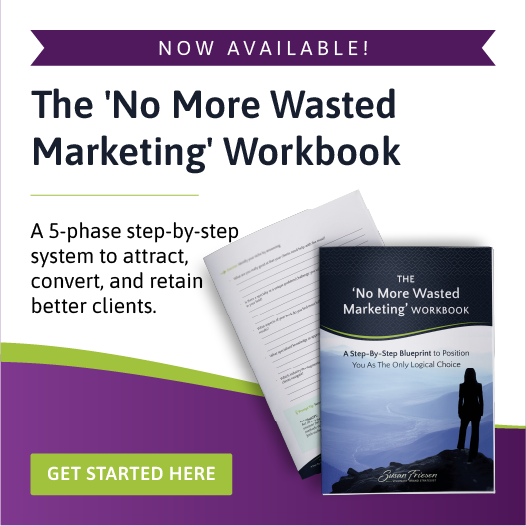
And that’s exactly what you’ll get in The ‘No More Wasted Marketing’ Workbook, a step-by-step guide to help you refine your brand positioning and uncover what makes your business stand out.
This isn’t just a workbook. It’s your roadmap to:
- Marketing that finally feels like it's working
- Offers that feel like a perfect fit (because they are)
- Magnetic messaging that speaks to your ideal client
- A brand that builds trust and authority at first glance
So, if you’re tired of attracting the wrong clients, or none at all, it’s time to change that.
Download The ‘No More Wasted Marketing’ Workbook Now and start building the kind of brand that your best clients just can’t ignore.

About the Author, Susan Friesen
Located in the lower mainland of B.C., Susan Friesen is a visionary brand strategist, entrepreneur, and founder of British Columbia’s premiere boutique web development and digital marketing agency, eVision Media.
With over 20 years of experience in the industry, she is an expert in helping businesses establish their online presence and create a strong brand identity.
Her passion for empowering entrepreneurs and small business owners to succeed in the digital world has earned her a reputation as a leading authority in the branding and marketing industry.
Visit www.BrandIdentitySteps.com and download your FREE guide: "Unlocking Customer Trust and Business Growth: Your 7-Step Guide to Defining a Compelling Brand Identity that Appeals to Your Perfect Clients".