What I couldn’t unsee after using AI myself
I’ll admit it.
When AI first became available to the general public, I was eager to give it a try.
After all, who wouldn’t be interested in a tool that could help you write faster, brainstorm ideas, create content, draft emails, summarize thoughts, and so much more?
As a business owner, I could see the appeal right away.
There is always more to write and more to publish. More ideas to flesh out, more services or offers to promote, and more platforms where we’re told we need to be engaged.
For a solo entrepreneur or small business owner, that pressure is always there. Even when you love your work and care deeply about helping your clients, the never-ending pressure to create more content can seriously drain your time and energy.
So yes, I gave it a try and let it help me create content. And honestly, it looked pretty good and even sounded impressive. And at first, I thought, “Wow, this is going to make life so much easier!”
Until I started noticing something.
Something seemed off.
After using it for a while and seeing more and more AI-generated content online, I began to recognize the same words, phrases, rhythms, and patterns showing up in all kinds of places, like Facebook posts, LinkedIn comments, email newsletters, and website copy.
And once I noticed it, I couldn’t unsee it.
The content often looked polished at first glance, but underneath the surface, it felt very familiar.
At first, the signs were easy to spot. There were too many em dashes, way too many emojis, and an overall tone that was too polished and not like a real person. The humanness was missing.
Sure, it sounded impressive at a glance, but something was not natural about it.
Then people started catching on to those obvious signs and started replacing the em dashes with ellipses and commas, so the patterns became less obvious.
But they were still there.
I started noticing the more subtle things. The same kinds of phrases would show up again and again. Certain sentence structures kept cropping up. Some words were being used so often that they started to stand out.
How many times have you seen or heard some version of, “you’re not broken… you’re just missing…”? Once a phrase like that starts appearing everywhere, it stops feeling personal and starts sounding like a template.
And then there were the lines that appeared meaningful at first, but when I carefully re-read them, I realized they didn’t actually mean anything at all. They were just a string of polished words that were grammatically correct but had no substance behind them.
AI does this a lot.
And that’s when I started to get concerned. Not for the use of AI itself. I use it, too.
What concerns me is how easily it can move from being a helpful assistant to becoming a replacement for a business owner’s own thinking, voice, and judgment.
And that is where the risk is.
AI can make your writing sound more polished while at the same time strip away the very cues people need to trust you: your unique perspective, your personal standards, your personality, and the way you naturally explain things.
When those cues are absent, your content may still look professional, but it becomes harder for people to recognize you in it. And if they stop recognizing you, they have less reason to remember you, believe you, or choose you.
This has become such an important subject in brand positioning that I decided not to tuck it away as a small mention in my upcoming book. So, I’m creating a separate companion guide that I can continue to update as AI, marketing, and buyer behaviours change.
Because this has moved far beyond content creation.
It now affects how people experience your brand, how clearly they understand what makes you different, and how much credibility they attach to what you put out into the world.
If your marketing starts sounding like everyone else’s, some people will recognize the AI patterns right away. And for those who are already skeptical of AI-generated content, that recognition can cause an instant loss of trust. They may start questioning your credibility, your attention to detail, and whether the words truly represent what you believe.
Others might not be able to name what is off. They may not say, “This was written by AI.” But they can still sense when something feels generic, overly polished, or inauthentic.
Either way, your marketing starts working against the very trust you are trying to build. Instead of helping people feel more confident in you, it gives them a reason to pause, question what they are reading, and wonder whether there is a real person behind the message.
And all of this can happen without you even realizing it.
That’s what concerns me most.
You may look at a polished AI-assisted draft and feel relieved that your writing finally sounds more professional. But professional is not the same as trustworthy. If the piece could have been written for anyone in your industry, it no longer has the details that help people understand who you are, how you think, and why your work is different.
And that’s where authenticity becomes a real advantage.
I don’t mean sharing personal details just for the sake of looking more relatable. I mean allowing your actual perspective, examples, values, and way of explaining things to come through in your marketing. Those are the pieces people recognize. Those are the pieces AI cannot create on its own.
And when too much of that gets handed over to a tool, your content may sound smoother, but your business becomes less differentiated from your competitors.
For service-based businesses especially, this is a serious issue. People are not only buying the service. They are often choosing the person, the thinking, the care, the experience, and the judgment behind that service.
Your marketing is not just content. It’s how people experience your brand before they ever download your freebie, make a purchase, or speak to you.
It tells them what you value, what you specialize in, and whether they should trust what you’re saying.
So, the bigger question is not whether AI can help you create content faster. The bigger question is whether your marketing still sounds and feels like it came from you.
Because as more businesses use the same tools to create the same kind of polished content, authenticity will become your competitive advantage.
The businesses that stand out will be the ones whose message still sounds real. Their marketing will carry a point of view, a story, and enough substance to help buyers think, “Yes, this is someone I can trust.”
And that’s where strong brand positioning comes alive.
When you know what you stand for, whom you serve, how you help, and what you want to be known for, you’re much less likely to let a tool flatten your message into something generic.
You don’t have to hand your voice over just because a tool helped with the draft.
You still get to decide what works, what gets rewritten, and what should never be associated with you at all. That takes discernment. And as more businesses lean on AI, discernment will become one of the most important ways to protect your authenticity and your competitive advantage.
Because authenticity is no longer just a nice personal quality. It’s becoming part of how people make buying choices.
And in a marketplace full of polished sameness, the business that sounds human, thoughtful, grounded, and real is going to stand out and build trust.
Until next time, I’m Susan Friesen, your small business brand positioning strategist, inviting you to stay clear, stay focused, and stand out.
PS: If you’ve been using AI and thinking, “This sounds pretty good,” I get it. I’ve had that same reaction, too. But before you publish, take a moment to ask: Does this still sound like me, or does it just sound polished? That quick pause may be what protects your authenticity, trust, and competitive advantage.
Ready to Attract Better Clients Without Working Harder?

You don’t need another crash course in funnels or hacks. You need clarity.
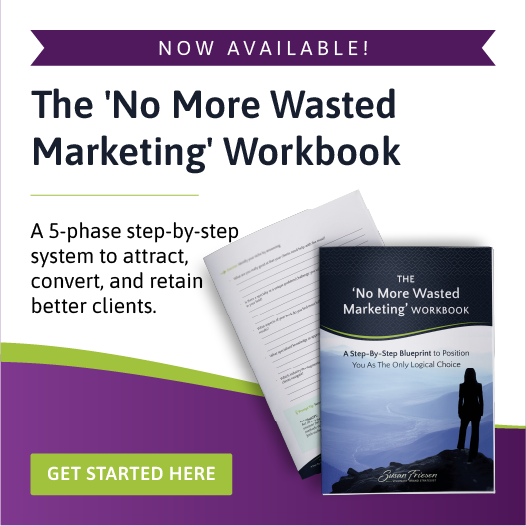
And that’s exactly what you’ll get in The ‘No More Wasted Marketing’ Workbook, a step-by-step guide to help you refine your brand positioning and uncover what makes your business stand out.
This isn’t just a workbook. It’s your roadmap to:
- Marketing that finally feels like it's working
- Offers that feel like a perfect fit (because they are)
- Magnetic messaging that speaks to your ideal client
- A brand that builds trust and authority at first glance
So, if you’re tired of attracting the wrong clients, or none at all, it’s time to change that.
Download The ‘No More Wasted Marketing’ Workbook Now and start building the kind of brand that your best clients just can’t ignore.

About the Author, Susan Friesen
Located in the lower mainland of B.C., Susan Friesen is a visionary brand strategist, entrepreneur, and founder of British Columbia’s premiere boutique web development and digital marketing agency, eVision Media.
With over 20 years of experience in the industry, she is an expert in helping businesses establish their online presence and create a strong brand identity.
Her passion for empowering entrepreneurs and small business owners to succeed in the digital world has earned her a reputation as a leading authority in the branding and marketing industry.
Visit www.BrandIdentitySteps.com and download your FREE guide: "Unlocking Customer Trust and Business Growth: Your 7-Step Guide to Defining a Compelling Brand Identity that Appeals to Your Perfect Clients".