How Does a Realistic Brand Promise Help Build Customer Trust?
A realistic brand promise helps build customer trust by setting clear expectations about the value and experience people can expect from your business.
When you consistently deliver on those expectations, customers gain confidence in your reliability and become more comfortable choosing, returning to, and recommending your business.
Your brand promise should reflect your business’ genuine strengths and capabilities, and it should guide how you communicate, serve customers, and make everyday business decisions.
Because when your marketing promises one thing but the customer experience suggests something else, that inconsistency can weaken credibility, erode trust, and damage relationships.
Key Takeaways:
- Set realistic expectations. Make promises your business can consistently fulfill rather than relying on exaggerated claims to attract customers.
- Be specific about your value. Replace vague statements such as “exceptional service” with clear commitments customers can recognize and evaluate.
- Keep your entire business aligned. Ensure your marketing, internal processes, employee behaviour, and customer experience all support your brand promise.
- Recognize the consequences of inconsistency. When your actions contradict your promises, customers may lose confidence, leave negative reviews, or hesitate to recommend your business.
- Evaluate and refine your promise. Use customer feedback and regular reviews of your business practices to ensure you’re continuing to meet the expectations you’ve created.
Imagine hiring a consultant whose website promises a highly personalized experience.
You look forward to working directly with someone who will take the time to understand your business. But after signing the agreement, you receive a standard questionnaire, a series of automated emails, and very little individual attention.
The consultant may be doing great work. But that wasn’t the experience you expected, was it?
The promise sounded appealing, but your interpretation of it was very different from what the business was actually trying to promise.
In my experience, this is one of the most common ways customer trust can be weakened, and typically, it will happen before business owners are even aware that anything’s gone wrong.
As a business owner, you need to consider what your marketing leads people to expect.
Are you making commitments you can actually fulfill? And does the way you run your business support those commitments?
Let’s take a closer look before things get even more out of hand.
What Is a Brand Promise?
Your brand promise is the commitment people should be able to count on when they choose your business.
It reflects the value you intend to provide, and the kind of experience clients can reasonably expect when working with you.
You may not have written that promise down, or even come up with one yet, but the truth is you still communicate it through things like your website, sales conversations, pricing, and advertising.
For example, a bookkeeping firm might emphasize accuracy, a therapist might promise a thoughtful, individualized approach, and a property management company might highlight its proactive communication with clients.
Each of these statements suggests something about how the business will behave once a client comes on board.
But a useful brand promise begins with knowing whom you serve, what those people value, and what your business is genuinely equipped to deliver.
That’s where brand positioning comes into the picture. You need to understand what you want to be known for before you can decide what people should be able to expect from you.
Because ultimately, your clients will decide whether your brand promise is believable based on what they see and experience, regardless of how carefully you’ve worded it.
Customers Start Forming Expectations Before They Hire You
Think about the last time you considered hiring a professional.
After visiting their website, reading reviews, and booking an introductory call, you probably had an impression of what working together might be like.
And your potential clients go through a similar process.
They notice what you emphasize, how you respond to questions, and whether the information they find seems consistent. And all of this shapes their expectations.
The difficulty is that broad claims leave way too much room for interpretation.
Say a consulting firm advertises “hands-on support.” As such, one prospect assumes they’ll receive guidance at important stages of a project, while another expects frequent meetings and direct access to a consultant whenever a question comes up.
If they haven’t explained what that hands-on support actually includes, then those two people may enter into the same service agreement expecting very different experiences.
But when people understand how your services work, what’s included, and their own responsibilities, then they can make a better-informed decision.
This also reduces the chance of you spending a good portion of the relationship correcting assumptions that could have been addressed early on.
All things considered, your brand promise becomes much more credible when customers know what it means and your actions are actually aligned with it.
Be Careful About Promising What Sounds Impressive
It’s tempting to make your business sound as appealing as possible, especially when competitors are making big claims of their own.
So, you may feel pressure to promise faster results, more attention, or a better outcome than anyone else.
But can you deliver on that promise consistently, including when your schedule is full or something unexpected happens?
Consider a marketing agency that advertises immediate responses to every client question. That sounds reassuring until the team is handling several major projects at once.
In this kind of situation, if response times become unpredictable, then the original claim starts working against the agency.
A more realistic commitment might explain when clients can expect a reply, how urgent issues are handled, and who their main contact will be. Those details may sound less dramatic or impressive, but they give a prospective client something more concrete to evaluate.
However, this doesn’t mean you should undersell your expertise or lower your standards.
What you should do is set expectations that reflect what you can reliably provide.
Read: How to Use Client Testimonials to Build Trust and Attract More of the Right Customers

Your brand promise sets expectations, but how can potential customers feel confident that you’ll actually deliver on them?
One way is by sharing testimonials from clients whose experiences demonstrate that your business actually follows through on its promises.
Among other things, this article explains how to collect meaningful testimonials and use them strategically to provide evidence of your brand promise, along with how to choose the ones that will reinforce your business’ strengths and attract clients who value what you offer.
How to Turn Broad Claims Into Expectations Clients Can Recognize
A lot of businesses use phrases like “exceptional service”, “high-quality work”, or “personalized solutions”. And it’s not hard to understand why.
These are qualities business owners genuinely care about and they want potential clients to know about them
The problem is nearly anyone can make those claims.
What’s more, they don’t tell a customer what makes your approach different or how they’ll recognize those qualities once they’ve hired you.
So, if you find any broad claims on your website, or in your other marketing materials, you should ask yourself: What would someone actually see or experience that proves we’re doing this?
If you can’t answer that question easily, then the claim you’re making may need to be revisited.
You also shouldn’t make specific commitments just because they look good in your marketing.
The aim is to communicate your real value more clearly, not create another set of promises you’re going to have difficulty keeping.
Why Your Brand Promise Should Guide Your Whole Business
Here’s where I think some business owners overlook the bigger picture: They tend to treat their brand promise as a marketing message that’s finished once their website copy has been approved.
But the experience of doing business with you is shaped by far more than just your marketing.
How you handle an initial inquiry, for instance, is crucial, and the same is true of the proposal a prospect receives, the way you onboard new clients, how your team deals with questions, or what happens when a project doesn’t go according to plan.
Suppose a company positions itself around careful attention to detail. Its proposals should be accurate, its team should understand the agreed scope, and its finished work should go through appropriate checks.
But if clients repeatedly find errors in documents or have to remind staff about details they’ve already provided, then the business is contradicting the very thing that it claims sets it apart.
And these inconsistencies can have some serious consequences.
For example, people may become more cautious about your recommendations or start questioning whether other promises will be kept.
Some may decide not to renew or refer you, and others may share their disappointment in a review or with colleagues. And for a small, service-based business, where relationships and reputation play such a large role, that can be costly.
At this point, I should mention that your brand promise can also be invaluable for helping you make better internal decisions.
When doing things like considering a new service, changing a process, hiring someone, or introducing automation, for instance, you should ask whether the change is aligned with your brand promise and if it supports the experience you want clients to have.
Check Whether Your Customers Actually Experience What You Promise
Business owners are often too close to their own operations to notice these kinds of inconsistencies.
You know how much effort goes into serving your clients, and you can explain why your processes work the way they do. But new customers see the experience from a different perspective.
And that’s why it’s worth reviewing the journey from their point of view.
One thing you can do is read through your website as if you’re someone who’s never met you or come across your business.
Consider what you’d expect after reading the claims you’ve made and then compare that impression with what actually happens when someone contacts your business and becomes a client.
You should also pay attention to things like recurring questions, misunderstandings, reviews, and feedback.
If several clients express surprise about a process or say they expected more frequent updates, there’s useful information there. Perhaps the service needs adjusting. Or maybe your marketing just needs to explain the experience more accurately.
At the same time, you’re going to want to look at what happy clients consistently mention.
Their comments can help identify strengths you already deliver but may not be communicating clearly enough.
So, make sure to revisit your brand promise as your business grows, as changes in staffing, services, workload, or delivery methods can affect what you’re able to offer.
Give Customers a Reason to Believe You
A strong brand promise gives people a reason to consider your business. But the experience you deliver determines whether they’ll continue to believe in that promise.
And that distinction matters because trust takes time to build.
Every interaction gives customers an opportunity to decide whether your business is living up to what it claims to stand for. And when those experiences consistently meet their expectations, they’ll become more confident in their decision to work with you.
That confidence can lead to stronger client relationships, repeat business, and referrals from people who feel comfortable putting their own reputation behind a recommendation.
At this point, I encourage you to take another look at the promises you’re making throughout your marketing.
Are they specific enough for customers to understand? Are they realistic for your business to deliver? And most importantly, does the experience you provide consistently support them?
Remember, your brand promise is something your business needs to live up to every day.
And when your words and actions consistently support one another, you’re giving customers something far more meaningful than an appealing marketing message.
You’re giving them a reason to trust you, and to keep trusting you.
Is your brand promise building customer trust or creating expectations you’re not meeting?
Book a free consultation and let’s look at whether your brand positioning, messaging, and customer experience are working together to communicate your value and build lasting trust.
To your business success,
Susan Friesen
P.S. If you liked the article, you might want to subscribe to our newsletter. We publish tons of valuable content to help you learn more about marketing, and subscribing is the best way to ensure you don’t miss out. Additionally, if you’d like to learn more about building a search engine optimized website, click here for our free website guide.
Ready to Attract Better Clients Without Working Harder?

You don’t need another crash course in funnels or hacks. You need clarity.
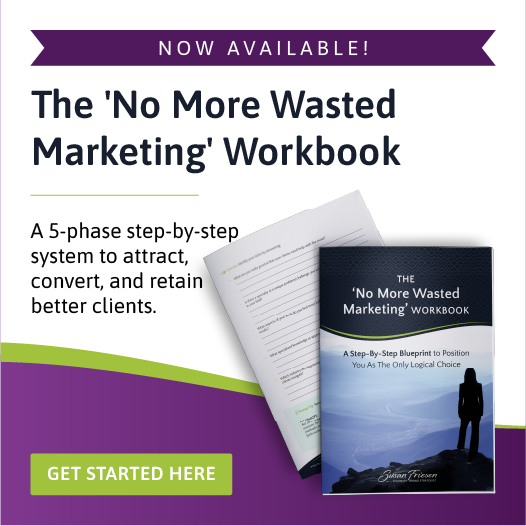
And that’s exactly what you’ll get in The ‘No More Wasted Marketing’ Workbook, a step-by-step guide to help you refine your brand positioning and uncover what makes your business stand out.
This isn’t just a workbook. It’s your roadmap to:
- Marketing that finally feels like it's working
- Offers that feel like a perfect fit (because they are)
- Magnetic messaging that speaks to your ideal client
- A brand that builds trust and authority at first glance
So, if you’re tired of attracting the wrong clients, or none at all, it’s time to change that.
Download The ‘No More Wasted Marketing’ Workbook Now and start building the kind of brand that your best clients just can’t ignore.

About the Author, Susan Friesen
Located in the lower mainland of B.C., Susan Friesen is a visionary brand strategist, entrepreneur, and founder of British Columbia’s premiere boutique web development and digital marketing agency, eVision Media.
With over 20 years of experience in the industry, she is an expert in helping businesses establish their online presence and create a strong brand identity.
Her passion for empowering entrepreneurs and small business owners to succeed in the digital world has earned her a reputation as a leading authority in the branding and marketing industry.
Visit www.BrandIdentitySteps.com and download your FREE guide: "Unlocking Customer Trust and Business Growth: Your 7-Step Guide to Defining a Compelling Brand Identity that Appeals to Your Perfect Clients".