Is Your Marketing Fixing the Wrong Problem?
If your marketing has been disappointing you lately, what is the first thing you think needs to change?
Is it that you have to do more social media posts?
Maybe you need to redo, or at least update, your website and finally get serious about SEO.
Or perhaps it’s time to put serious money into Google Ads.
Those all sound pretty reasonable.
But where do you begin?
Hold on. Before you change anything, I want you to consider this important question:
Have I actually diagnosed the problem correctly?
Hi, I’m Susan Friesen, Small Business Brand Positioning Strategist and founder of eVision Media.
In these Stand Out & Thrive videos, I help service-based business owners understand what may really be getting in the way of their marketing results, so they can make better decisions about where to spend their time, energy and money.
And if that sounds useful to you, I’d love for you to subscribe to my channel so you don’t miss future videos.
Now, it’s funny how this idea of diagnosing the right problem can relate to our personal life too.
I was reminded of that during a trip to the dentist last week.
I had booked my annual cleaning, and this time I also asked them to do a checkup and some X-rays because I had been feeling a little bit of pain in my lower left jaw.
It wasn’t terrible toothache kind of pain. More like an annoying sensation that would come and go.
And I really wasn’t that worried about it because I had experienced something similar before.
The last time, we had determined that I was holding a lot of tension in my jaw, and that tension was causing the discomfort.
So naturally, I assumed that was what was happening again.
When I got there, I mentioned it to the hygienist. I basically said, “I’m having a little bit of pain down here. I’m pretty sure it’s a result of feeling stress in my jaw, but maybe we should make sure a filling hasn’t come loose or something.”
She took the X-rays and then asked me a very specific question.
“When does the pain happen?”
I said it was on and off.
And she asked again, “But when do you notice it? Is it just there, or does it happen when you chew?”
And I thought about it and said, “Oh. Yes. It does happen when I chew.”
She paused.
Then she said, “We need to take more X-rays. I need to see what’s happening with the root.”
Well, that got my attention.
We carried on with the cleaning, and then the dentist came in, looked at those X-rays and told me I had a small infection at the bottom of a tooth where I had previously had a root canal.
That was definitely not what I had assumed was going on.
I had taken a symptom I recognized and attached an old explanation to it.
The symptom was real.
But my assumption about what was causing it was completely incorrect.
Stress had nothing to do with it!
And this is something I see small business owners doing with their marketing all the time.
They see a symptom, like leads or sales have slowed down.
Or people are visiting the website but not booking discovery calls.
Maybe they are getting leads, but those leads are not a good fit and don’t convert.
They’re putting a lot of effort towards social media but getting very little response.
Or people seem interested until they hear the price.
Those are all symptoms that many of us have encountered over the life of our business.
And then comes the diagnosis:
“My marketing isn’t working.”
Which can quickly turn into a panic-filled, “I need to do more marketing.”
Bound and determined to get it right this time, you start tweaking this and changing that, but without really knowing what you are trying to fix.
This is where I want you to slow things down a bit.
Because a marketing problem and a brand positioning problem can look very similar from the outside.
So let me explain the difference.
Your brand positioning determines what you want people to understand about your business.
Who are you particularly well suited to help?
What do you want to be known for?
What problem or need are you best equipped to help them with?
And what gives someone a valid reason to choose you rather than one of the other options they are considering?
Your messaging takes those decisions and puts them into words.
Then your marketing puts those words out into the marketplace.
So if those things were never really defined in the first place, doing more marketing can simply spread the same undefined message further.
Take your website, for example.
You could invest in a beautiful new design, but if someone lands on that site and still cannot figure out what makes your business particularly relevant to them, the design is not going to answer that question for you.
SEO can increase the number of people finding your website.
But once they arrive, your positioning still has to give them a reason to stay, pay attention and seriously consider working with you.
Advertising can give you more exposure.
Social media can keep you visible.
AI can help you produce content much faster.
But none of those things can determine what your business should be known for.
They all work with what you give them.
And this becomes especially important for businesses that have been around for a while.
Your business may have changed quite a bit over the past five or ten years.
You have more experience now.
You may have developed a specialty.
Perhaps there is a certain type of client you do your best work with.
Your services and pricing may have changed, and the results you get for your clients may be very different from what you were offering when your website was first written.
Yet your marketing may still be introducing the older version of your business.
I see this happen a lot.
The business itself has matured, but the positioning never caught up.
Then when you look at the poor results, you think the answer is more traffic or more promotion.
That is a little bit like me assuming the pain in my jaw was tension and trying to solve that problem when there was actually an infection sitting underneath it.
I could have been doing all kinds of jaw-relaxing techniques I learned from YouTube while completely ignoring the thing that actually needed attention.
So how do you avoid doing the marketing equivalent of that?
Start by getting more specific about the symptom.
Instead of saying, “My marketing isn’t working,” figure out what is actually happening.
Are people not finding you?
Are they finding you but not taking the next step?
Or are you attracting people who are not a good fit in the first place?
Those are three very different problems.
And they may require very different solutions.
Then take a closer look at your positioning before deciding which marketing tactic needs to change.
Does your current message accurately reflect the business you have today?
Could someone quickly understand whom you are best suited to help?
And are you giving them a clear enough reason to choose you?
Pay attention to the patterns you are seeing too.
If people repeatedly misunderstand what you do, you keep attracting the wrong type of inquiry, or conversations keep coming back to price, those results are telling you something about the message your marketing is putting out.
That’s useful information.
The trick is not immediately reacting to it by doing more.
My hygienist could have accepted my explanation about jaw tension and carried on with the cleaning.
Instead, she asked one more question.
And that one question changed the diagnosis completely.
I think there’s a really good business lesson in that.
When your marketing isn’t producing the results you expected, resist that immediate urge to start changing everything.
Get more specific about what is actually happening first.
Then take a closer look at whether your positioning and message are contributing to the problem before deciding that you need more traffic, more content, more advertising or a different marketing tactic altogether.
Sometimes the marketing tactic genuinely does need fixing.
But sometimes, as I discovered at the dentist, the real problem is sitting further underneath.
And the sooner you diagnose the right problem, the less time, money and effort you’ll waste trying to fix the wrong one.
If this has you looking at your own marketing a little differently, I’d love for you to subscribe for more practical brand positioning insights.
Until next time, I’m Susan Friesen, your small business brand positioning strategist, inviting you to stay clear, stay focused, and stand out.
Ready to Attract Better Clients Without Working Harder?

You don’t need another crash course in funnels or hacks. You need clarity.
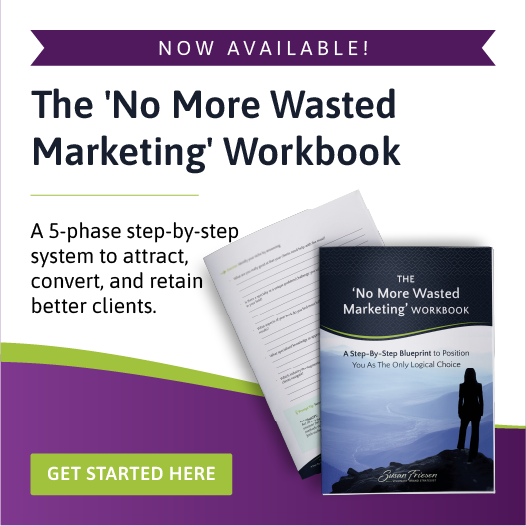
And that’s exactly what you’ll get in The ‘No More Wasted Marketing’ Workbook, a step-by-step guide to help you refine your brand positioning and uncover what makes your business stand out.
This isn’t just a workbook. It’s your roadmap to:
- Marketing that finally feels like it's working
- Offers that feel like a perfect fit (because they are)
- Magnetic messaging that speaks to your ideal client
- A brand that builds trust and authority at first glance
So, if you’re tired of attracting the wrong clients, or none at all, it’s time to change that.
Download The ‘No More Wasted Marketing’ Workbook Now and start building the kind of brand that your best clients just can’t ignore.

About the Author, Susan Friesen
Located in the lower mainland of B.C., Susan Friesen is a visionary brand strategist, entrepreneur, and founder of British Columbia’s premiere boutique web development and digital marketing agency, eVision Media.
With over 20 years of experience in the industry, she is an expert in helping businesses establish their online presence and create a strong brand identity.
Her passion for empowering entrepreneurs and small business owners to succeed in the digital world has earned her a reputation as a leading authority in the branding and marketing industry.
Visit www.BrandIdentitySteps.com and download your FREE guide: "Unlocking Customer Trust and Business Growth: Your 7-Step Guide to Defining a Compelling Brand Identity that Appeals to Your Perfect Clients".