
Why positioning needs to come before promotion
When your marketing isn’t bringing in the leads, clients, or sales you expected, what’s the first thing you do?
For many business owners, the instinct is to do more.
Run some ads, create a new offer, post more often, or try a different strategy.
But sometimes the problem isn’t how much marketing you’re doing. It’s what that marketing is communicating about your business.
A few weeks ago, I packed up my laptop and headed to Harrison Hot Springs for a five-day “workation” so I could finish the second draft of my upcoming book, Position Strong.
With beautiful weather all week, I made a point of getting outside for a couple of long walks each day.
I’d work on a chapter or two, head out for a walk, then come back and continue with fresh eyes. Often, that little bit of distance helped me see where I’d overexplained something or drifted away from the point I was trying to make.
One of the more interesting, and maybe even frustrating, parts of writing this book has been figuring out how to explain the knowledge base that has become second nature to me.
I’ve spent more than 25 years helping service-based business owners with their brands, websites, messaging, and marketing. And somewhere along the way, I realized we’d been doing brand positioning work long before I ever called it that.
Before we could build an effective website or develop a marketing strategy, we needed to understand the business first.
Whom did it serve?
What made it different?
What did the owner want to be known for?
What mattered to the people they wanted to attract?
What did those people need to understand before they would feel confident choosing that business?
When those pieces weren’t properly defined, we could usually see the effects later in the website and marketing.
The website looked great, and the marketing campaigns reached plenty of people, but the conversions often fell short of what the business owner expected.
Over the years, we started asking better questions. We looked more closely at the audience, the message, the market, the business model, the client experience, and the value being communicated.
Eventually, I realized there was a name for what we had been doing all along: brand positioning.
Writing Position Strong meant taking all of those years of experience and turning them into something another small business owner could understand and use.
And that proved harder than I expected.
Every business is different, and the way people decide whether to hire a consultant, a lawyer, a health professional, or another service provider can vary quite a bit.
And at the same time, I wanted the book to be relevant to a wide range of service-based business owners without making the advice so general that it lost its value.
Oddly enough, the Growth section is what gave me the most trouble.
I kept drifting into content strategy, thought leadership, launches, campaigns, and other marketing ideas.
It was good advice, and definitely the kind of thing I’d talk through with a client. But in the book, it was taking me too far into marketing tactics and away from the positioning work I wanted to stay focused on.
So, I had to keep reminding myself of a simple question: Does this help the reader understand the role brand positioning plays in growth, or am I taking them somewhere else?
If I was taking them somewhere else, I removed it, albeit with a heavy heart, as it was good stuff!
As I was ruthlessly cutting those sections, I realized business owners can fall into the same trap with their marketing. We can become so focused on adding or changing things that we miss the bigger question: Is the business being positioned the way we intend?
Not long ago, we worked with a med-spa that was attracting a lot of tire-kickers and people who said they couldn’t afford the services.
The owner contacted us, thinking the answer was paid advertising. If we could reach more of the right people, she believed the problem would improve.
But when we took a look at her website and social media, it became pretty clear that ads weren’t going to help if everything else stayed the same.
The business itself offered high-quality services backed by exceptional expertise. But you wouldn’t have known that from the website or social media.
The brand came across as a general, lower-end provider without any real distinct specialization.
There was a disconnect between the quality of the business she had built and the way it was coming across online.
More advertising would simply have sent more people to the same impression.
That’s the part of marketing I wish more entrepreneurs stopped to consider.
Your website, social media, offers, visuals, content, and advertising are all communicating something about your business.
But are they communicating what you intended?
That med-spa is a good example of why I keep coming back to positioning. Before spending money to get more people to the website, we needed to make sure the website was giving them an accurate picture of the business.
I think this is where a lot of business owners get frustrated. We naturally look at the visible parts of our marketing when the results aren’t what we expected, without always considering whether the business is coming across the way we intended.
Writing this book has helped me put words to something I’ve seen for years. You can know your work inside and out and still struggle to communicate its value to someone who isn’t as close to the business as you are.
The same thing can happen with your marketing. Your ideal client may be seeing your business and still not fully understanding how your expertise applies to their situation, what makes your approach different, or why they should choose you over another option.
That’s where positioning comes in.
By the end of those five days in Harrison, I was even more aware of the gap that can exist between the business you’ve actually built and the way people perceive it from the outside.
And when that gap exists, reaching more people isn’t necessarily going to fix it. Before you invest in more promotion, people need to be able to see and understand the value that’s already there.
Until next time, I’m Susan Friesen, your small business brand positioning strategist, inviting you to stay clear, stay focused, and stand out.
P.S. If this has you wondering whether your own marketing still reflects the business you’ve built, that’s exactly the kind of issue I’m exploring in Position Strong. I’m still working on the book now, and I’ll be sharing more as it gets closer to publication.
Ready to Attract Better Clients Without Working Harder?

You don’t need another crash course in funnels or hacks. You need clarity.
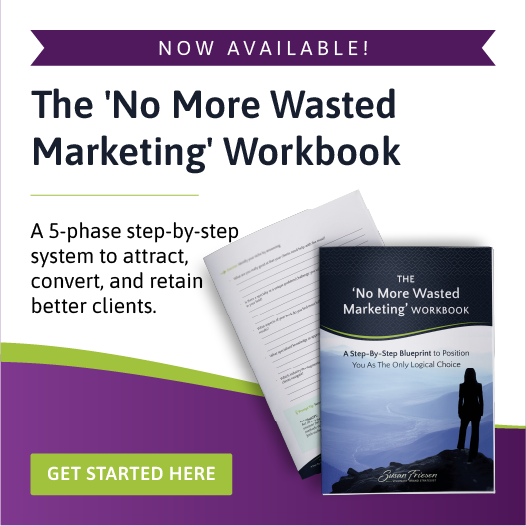
And that’s exactly what you’ll get in The ‘No More Wasted Marketing’ Workbook, a step-by-step guide to help you refine your brand positioning and uncover what makes your business stand out.
This isn’t just a workbook. It’s your roadmap to:
- Marketing that finally feels like it's working
- Offers that feel like a perfect fit (because they are)
- Magnetic messaging that speaks to your ideal client
- A brand that builds trust and authority at first glance
So, if you’re tired of attracting the wrong clients, or none at all, it’s time to change that.
Download The ‘No More Wasted Marketing’ Workbook Now and start building the kind of brand that your best clients just can’t ignore.

About the Author, Susan Friesen
Located in the lower mainland of B.C., Susan Friesen is a visionary brand strategist, entrepreneur, and founder of British Columbia’s premiere boutique web development and digital marketing agency, eVision Media.
With over 20 years of experience in the industry, she is an expert in helping businesses establish their online presence and create a strong brand identity.
Her passion for empowering entrepreneurs and small business owners to succeed in the digital world has earned her a reputation as a leading authority in the branding and marketing industry.
Visit www.BrandIdentitySteps.com and download your FREE guide: "Unlocking Customer Trust and Business Growth: Your 7-Step Guide to Defining a Compelling Brand Identity that Appeals to Your Perfect Clients".