More Marketing Won’t Fix a Positioning Problem
Have you ever put time and money into your marketing, only to wonder why it isn’t bringing in the leads and sales you expected?
In frustration, you find yourself pleading with your computer, “What else am I supposed to do?”
I put up a website and had it optimized for SEO.
I post all the time on social media and even run ads.
I send out newsletters whenever I can.
Yet nothing is happening the way I expected!
(Pause) Does any of this sound familiar?
Sure, you may get some leads coming in, but they’re not always a good fit.
Some seem interested enough… until they hear the price.
Others want, and even expect, far more than what they are willing to pay.
Of course, when this happens, the natural response is to change your marketing.
And honestly, it makes perfect sense to go there.
When marketing is not producing the results you want, it’s logical to assume the marketing itself must be the problem.
(P) But what if the real issue started before the marketing ever began?
What if it’s actually a brand positioning problem?
(P-Q) If that’s the case, doing more marketing will not solve things.
In fact, it may intensify the problem.
Hi, I’m Susan Friesen, your small business brand positioning strategist.
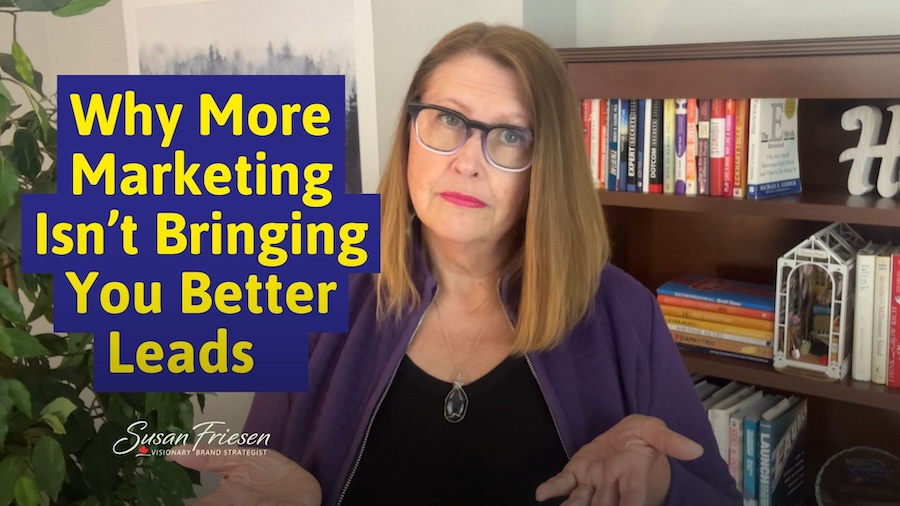
In today’s Stand Out & Thrive video, I want to explain why marketing tactics cannot make up for unclear positioning, how positioning affects every part of your marketing, and even your business as a whole, and what you can look at before spending more time or money trying to improve your results.
If this is already sounding familiar, subscribe to my channel for more practical brand positioning insights that will help you make better marketing decisions.
Most of the marketing advice you see out there is centred around activity.
You are told to publish more content, record more videos, send more emails, improve your search engine rankings, run ads, and of course, the cherry on top is to stay visible.
That kind of advice makes marketing more like a volume problem.
It’s all in the math.
If ten posts did not work, then try twenty.
If your website is not generating enough inquiries, it must need more traffic.
If an ad campaign did not produce enough leads, the budget must have been too small.
And yes, sometimes those things can be true.
A $50 ad budget is not going to give you the same kind of exposure as a budget of $500 or more.
But before increasing all of that activity, you first need to determine whether the message being amplified is clear enough.
Because that’s what marketing does. It creates exposure.
(P-E) Brand positioning gives that exposure purpose and meaning.
Your positioning helps people understand who you help, what you want to be known for, how your work is different, and why someone should choose your business instead of another option.
Marketing takes that position and puts it in front of the people you want to reach in the marketplace.
Your website communicates it.
Your social media reinforces it.
Your SEO helps people find it.
Your advertising puts it in front of more people.
Your email marketing keeps it familiar.
Your content proves that you understand the problem your ideal client is experiencing and that you have informed insights to share about it.
It helps establish your authority in that space.
(Q-E) But none of those marketing activities can define your position for you.
(P)They can only work with what has already been defined.
Think about a service-based business that describes itself using the same language as nearly every competitor.
It offers personalized service backed by years of experience.
It cares about its clients and provides quality work.
All of that is most likely true.
But none of it gives a prospective client enough information to understand and trust why this business is the better choice for their particular situation.
This is why doing more marketing misses the mark.
You might get more attention, but that attention is still coming through a message that does not give people a strong enough reason to choose you.
This is also why more visibility does not always produce more leads and signups.
(P-Q) Visibility doesn’t mean you are understood.
You can rank on Google and drive more people to your website, yet still have them leave without contacting you.
You can publish consistently and still have people forget what you do.
You can use AI to create more content, but if your position is unclear, you are simply producing more content that says very little about why someone should choose you.
The problem is that the business has not given all of these tools and tactics a strong enough position to communicate.
I saw this with a service-based business that kept attracting price shoppers and people who claimed they could not afford the services.
The owner believed the solution was more advertising.
From her perspective, she simply needed to reach more people in the areas she wanted to serve.
But when we reviewed the website and social media presence, it became clear that the problem went much deeper.
The business looked like a low-cost general provider.
There was no clear specialty.
The visuals did not reflect the quality of the service.
The message did not explain the level of expertise involved or why the experience was worth paying more for.
Advertising would have sent more people into that same impression.
It would have increased traffic without changing the reason people were responding the way they were.
So no, that business did not need more promotion first.
It needed to decide how it wanted to be understood and perceived by its ideal client.
That is the work of positioning.
Weak positioning often shows up through the types of marketing results you receive.
You may attract people who want the lowest possible price because your message does not communicate another reason to choose you.
You may receive few or poor-quality inquiries because your website is not specific enough about whom you help.
You may find yourself repeatedly explaining what makes your service different because your marketing is not doing that work before someone contacts you.
Or worse, someone may have been an ideal client but never took that next step because they couldn’t see themselves in your positioning.
You may also notice that your marketing used to work better than it does now.
That can happen when the business has evolved, but the positioning has not kept up.
Perhaps you’ve gained a great deal of expertise over the years.
Or your services have changed.
The quality of your work is stronger than it was several years ago and, as a result, your prices have increased.
(Q) Yet your website, message, visuals, and content still present an earlier version of the business.
(E) And that creates a disconnect.
The marketing may still be attracting the audience your business was positioned for five years ago rather than the audience you want to serve today.
This is why brand positioning cannot be treated as a one-time branding exercise.
It needs to reflect the business you are operating now.
So what should you look at before deciding you need more marketing?
Start with the people who are currently responding to it.
Are you attracting the kinds of clients you most want to work with?
Do they understand the level of service you provide?
Are they coming to you because of your expertise, or are they comparing you mainly on price?
Do they already have some appreciation for the value of your work, or do you have to convince them from the beginning?
The quality of your inquiries often tells you something about the position your marketing is communicating.
Next, look at the message itself.
Can someone quickly understand who your business is best suited for?
Is the problem you solve specific enough?
Does your message explain why your approach is useful, relevant, or different?
Could the same wording be placed on a competitor’s website without anyone noticing?
If it could, the message probably needs more work.
Then look at your marketing as a whole.
Does your website present the same position as your social media?
Does your content reinforce what you want to be known for?
Are your ads bringing people to a page that continues the same message?
Are your SEO topics connected to the services and clients you actually want?
Is your AI-assisted content being guided by your point of view, your experience, and your understanding of your audience?
Every channel should be supporting the same basic understanding of your business.
That does not mean repeating the same sentence everywhere.
It means the overall message remains consistent enough that people begin to recognize what you stand for and where your expertise fits.
Here is a simple exercise you can begin with.
Write down the three main reasons you believe someone should choose your business.
Then remove anything that could easily be claimed by most of your competitors.
Words such as quality, service, passion, experience, and personal attention are meaningful, but they are usually not enough on their own.
Go deeper.
What do you understand about your clients that others may overlook?
What specific problems are you especially good at helping them solve?
What do clients value most about the way you work?
What do you want your business to be known for a year from now?
Your answers will begin to show whether your marketing has a clear position to communicate.
Now, don’t get me wrong. This does not mean every disappointing marketing result is caused by positioning.
Marketing still needs to be planned, implemented, monitored, tested, and tweaked.
Your website needs to be optimized for the search terms that reflect your position and give your ideal client an immediate sense that they have landed in the right place.
Your content and ads need to be specific to your target audience.
Your marketing channels also need to work together rather than operating as a collection of disconnected activities.
Think of your brand position as a marketing decision filter.
It helps you determine which opportunities fit, which topics are best to focus on, which audiences you are speaking to, and which marketing ideas are likely to distract you from where you are trying to go.
So before you assume you need to market more, take a closer look at what your current marketing is communicating.
Is it clearly showing people who you help, what you want to be known for, and why your business is worth choosing?
That work needs to happen first.
Once it does, your website, content, SEO, social media, advertising, email marketing, and AI tools have a much stronger foundation to build from.
The next time your marketing feels disappointing, resist the urge to immediately add another tactic.
Ask a different question.
Is the problem that too few people are seeing my marketing, or is the problem that the people who see it do not have a clear enough reason to choose me?
The answer may change what you work on next.
Until next time, I’m Susan Friesen, your small business brand positioning strategist, inviting you to stay clear, stay focused, and stand out.
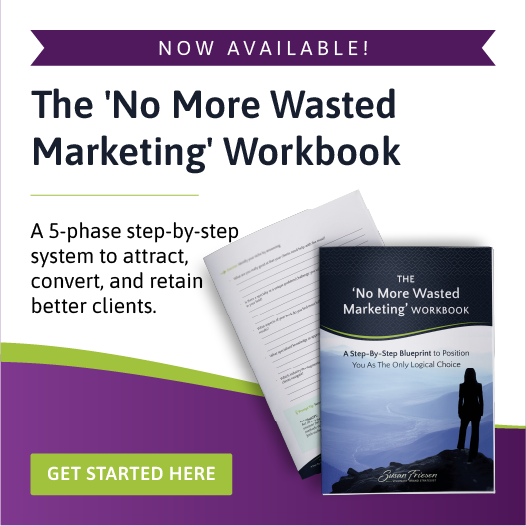
Ready to Attract Better Clients Without Working Harder?

You don’t need another crash course in funnels or hacks. You need clarity.
And that’s exactly what you’ll get in The ‘No More Wasted Marketing’ Workbook, a step-by-step guide to help you refine your brand positioning and uncover what makes your business stand out.
This isn’t just a workbook. It’s your roadmap to:
- Marketing that finally feels like it's working
- Offers that feel like a perfect fit (because they are)
- Magnetic messaging that speaks to your ideal client
- A brand that builds trust and authority at first glance
So, if you’re tired of attracting the wrong clients, or none at all, it’s time to change that.
Download The ‘No More Wasted Marketing’ Workbook Now and start building the kind of brand that your best clients just can’t ignore.

About the Author, Susan Friesen
Located in the lower mainland of B.C., Susan Friesen is a visionary brand strategist, entrepreneur, and founder of British Columbia’s premiere boutique web development and digital marketing agency, eVision Media.
With over 20 years of experience in the industry, she is an expert in helping businesses establish their online presence and create a strong brand identity.
Her passion for empowering entrepreneurs and small business owners to succeed in the digital world has earned her a reputation as a leading authority in the branding and marketing industry.
Visit www.BrandIdentitySteps.com and download your FREE guide: "Unlocking Customer Trust and Business Growth: Your 7-Step Guide to Defining a Compelling Brand Identity that Appeals to Your Perfect Clients".