
What Does It Mean to Be Strategic in Business?
Being strategic in business means making decisions based on clear goals, strong brand positioning, and a deep understanding of your target audience.
Instead of reacting to every new idea or marketing trend, you focus your time and resources on the actions that support where you want your business to go.
A clear strategy also helps you understand what not to do, as it gives you a practical filter for deciding which opportunities fit, which marketing activities deserve priority, and which tasks are simply keeping you busy.
Key Takeaways:
- Strategic decisions should support a defined business goal and direction.
- Being busy doesn’t always mean your business is making meaningful progress.
- Clear brand positioning helps every marketing activity work toward the same purpose.
- Understanding your target audience helps you create messages that address what they care about.
- A strong strategy helps you stop spending time on tasks that look productive but produce little value.
There’s a certain satisfaction that comes from being busy.
You answer emails, update your website, create social media posts, experiment with AI tools, and finally cross several things off your to-do list.
And by the end of the day, you may feel tired enough to assume you’ve made meaningful progress.
But did you?
That’s the question many small business owners avoid asking because the answer can be uncomfortable.
A full schedule can create the feeling that your business is moving forward, even when the work is not connected to a clear direction.
This is especially common in marketing.
When leads are slow, engagement drops, or sales feel inconsistent, the instinct is often to do more, whether that’s creating more content, posting more often, reworking your website, or building another lead magnet.
But the problem is doing more marketing won’t necessarily improve your results.
Because if what you’re doing isn’t guided by clear brand positioning and a deep understanding of your target audience, it can keep you busy without making your business more relevant, memorable, or trusted.
What Being Busy in Business Often Looks Like
Being busy in business can look productive from the outside.
You may be publishing regularly, changing your website copy, updating graphics, creating new offers, and doing whatever you can to try and stay visible.
None of those activities are inherently wrong.
The real issue is whether you can explain why you’re doing them.
For instance, if someone asked you the following questions about a piece of content, would you be able to easily and succinctly answer them?
- Whom is it meant to reach?
- Why are you creating that content?
- What do you want your audience to understand after reading it?
- How does it support what you want your business to be known for?
When those questions are difficult to answer, it’s easy for your marketing to become a collection of tasks rather than a strategy.
And this is where productive avoidance can appear.
Productive avoidance happens when you choose work that feels useful but keeps you from making the harder decisions your business actually needs.
The work keeps you occupied, but it doesn’t inform your strategy or resolve deeper issues.
Why Busyness Feels Safer Than Strategy
There’s a reason why so many business owners fall into this pattern.
Tasks feel concrete, as you can finish them and cross them off a list, which gives you an immediate sense of accomplishment.
But strategic thinking is different.
It requires you to slow down long enough to make decisions, which may force you to let go of ideas you like, narrow your focus, change how you describe your work, or admit that your current marketing is based more on assumptions than evidence.
And that can feel extremely risky.
At this point, it may seem safer to keep moving than to stop and question whether you’re moving in the right direction.
Activity also gives you relief from uncertainty because when your marketing isn’t producing the results you want, doing something tends to feel better than doing nothing.
All things considered, the missing piece here is a structure for deciding what deserves your attention and what doesn’t.
What Being Strategic in Business Actually Means
Being strategic in business means making decisions based on direction rather than pressure.
It means knowing where you want your business to go, whom you most want to serve, what you want to be known for, and what needs to happen next.
It doesn’t require a complicated plan filled with a bunch of jargon.
A useful strategy should help you decide which marketing activities deserve your time, which opportunities fit your direction, what messages need to be repeated, and what you can stop doing.
Being strategic in business also means understanding that every good idea doesn’t need to become a time and resource draining project.
A new platform may look promising, but that doesn’t mean your audience is there. And a popular tactic may work for someone else, but that doesn’t mean it’ll fit your business model.
In any case, if you have a strategy for your marketing, then you’ve also got a filter.
And without that filter, every new idea can feel urgent.
But when you have that filter, you can make calmer decisions because you know what you’re trying to accomplish with your business and what doesn’t belong in the plan.
Read: Why Your Marketing Isn’t Attracting the Right Clients

If you’re staying visible but still attracting people who question your value, want services you no longer offer, or just aren’t a good fit, the amount of marketing you produce may not be the issue.
This related article explains how broad or unclear positioning can prevent your ideal clients from recognizing why your business is relevant to them.
What’s more, it’ll help you learn why greater focus can lead to stronger inquiries, clearer referrals, and less time spent convincing people to work with you.
Why Brand Positioning Must Guide Your Strategy
No matter how you slice it, marketing becomes much easier to evaluate when it’s guided by clear brand positioning.
Brand positioning helps people understand whom you help, what you’re known for, how your work connects to what your target audience needs, and why they should choose you.
This goes much deeper than a logo, colour palette, tagline, or polished website.
Your positioning affects the offers you create, the language you use, the content you publish, the proof you share, and the way your website guides people.
And it also affects what you choose not to do.
At any rate, when your positioning is unclear, your message often changes from one piece of content to the next.
As a result, people may see that you’re active, but they still won’t understand what makes your business relevant to them.
And more marketing will not fix that.
More likely, it’ll just make the confusion more visible because you’re repeating an unclear or inconsistent message in more places.
Clear positioning, on the other hand, gives your marketing a centre of gravity.
It keeps your message connected to the same core audience, value, and point of view, while allowing each act of marketing to reinforce the others, rather than competing for attention.
You Can’t Be Strategic Without Understanding Your Target Audience
A clear strategy also depends on how well you understand your target audience.
However, many business owners believe they already know their audience because they can describe them in broad terms.
They may say they work with female entrepreneurs, small business owners, health professionals, or service providers.
But that’s just a starting point, and it’s not enough to guide strong marketing decisions.
You need to understand what your audience is dealing with right now. So, ask yourself:
- What are they trying to solve?
- What have they already tried?
- What are they afraid of getting wrong?
- What do they misunderstand about the problem?
- What makes them hesitate before spending money?
- What do they need to believe before they feel ready to move forward?
These details shape the way your marketing should be written, affecting the topics you choose, the examples you use, the objections you address, and the proof you provide.
You may produce content around things like your expertise, services, methods, or credentials.
And while all of that may be relevant, it doesn’t automatically answer the questions your audience is asking.
Your target audience is trying to make sense of their own situation.
They want to know whether you understand what they’re experiencing, whether your approach fits, and whether working with you feels like a wise decision.
Without that understanding, marketing becomes guesswork. You may keep producing content, but the message can miss the concern that’s actually keeping people from acting.
A Better Way to Decide What Deserves Your Time
Before adding another marketing task to your list, you should pause and ask a few questions, including:
- Whom is this meant to reach?
- Which business goal does this support?
- Is this the most useful action I can take right now?
- What do I want my audience to understand, believe, or do?
- Does this reinforce what I want my business to be known for?
These questions can expose whether a task is strategic or simply familiar.
Moreover, they can also help you stop doing work that’s become routine but no longer serves a clear purpose.
With that in mind, here are some dead giveaways that your marketing is missing a strategy:
- You create content without knowing what idea it’s meant to reinforce.
- You keep changing tactics before giving a clear strategy enough time to work.
- You cannot explain why one marketing activity deserves priority over another.
- You follow trends that have little connection to your audience or business goals.
- You resist narrowing your message because you’re afraid of losing opportunities.
- You spend more time polishing your marketing than deciding what it needs to communicate.
- You keep looking for a better tactic instead of examining the foundation underneath the tactics you already use.
All things considered, being strategic doesn’t mean you have to stop marketing.
What it means is your marketing will be following a clear plan, rather than being done randomly.
You may still create content, update your website, refine your offer, or test a new channel.
But the difference is that each activity now has a reason. You’ll know whom it’s for, what it should communicate, and how it connects to your positioning.
And that kind of clarity makes marketing easier to manage because you’re no longer treating every idea as equally important.
Progress Comes From Direction, Not Volume
A packed calendar can make you feel as though your business is moving forward.
And sometimes it is. But sometimes it’s simply keeping you occupied.
The difference comes down to whether your activity is guided by clear decisions.
When your brand positioning is strong and your understanding of your target audience goes beyond surface-level demographics, your marketing has a much better chance of doing what it’s supposed to do.
It helps people understand your value, gives them a reason to trust you, and makes your business easier to remember and easier to choose.
So, before adding any more marketing to your schedule, ask yourself one honest question:
Does this support the direction of my business, or does it simply give me something else to do?
Is marketing keeping you busy without moving your business forward?
Book a free consultation and let’s look at where your marketing is losing focus, so you can make clearer decisions about what deserves your time and attention.
To your business success,
Susan Friesen
P.S. If you liked the article, you might want to subscribe to our newsletter. We publish tons of valuable content to help you learn more about marketing, and subscribing is the best way to ensure you don’t miss out. Additionally, if you’d like to learn more about building a search engine optimized website, click here for our free website guide.
Ready to Attract Better Clients Without Working Harder?

You don’t need another crash course in funnels or hacks. You need clarity.
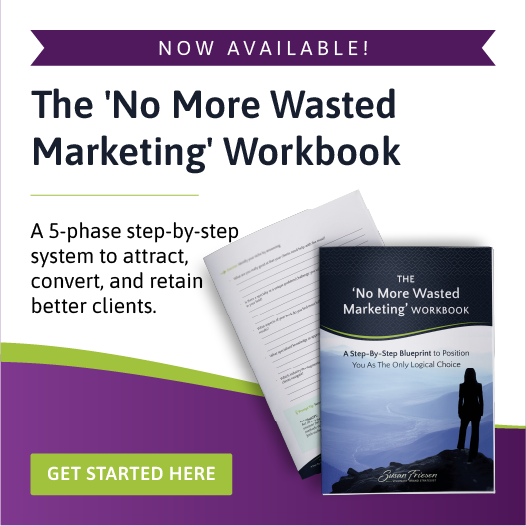
And that’s exactly what you’ll get in The ‘No More Wasted Marketing’ Workbook, a step-by-step guide to help you refine your brand positioning and uncover what makes your business stand out.
This isn’t just a workbook. It’s your roadmap to:
- Marketing that finally feels like it's working
- Offers that feel like a perfect fit (because they are)
- Magnetic messaging that speaks to your ideal client
- A brand that builds trust and authority at first glance
So, if you’re tired of attracting the wrong clients, or none at all, it’s time to change that.
Download The ‘No More Wasted Marketing’ Workbook Now and start building the kind of brand that your best clients just can’t ignore.

About the Author, Susan Friesen
Located in the lower mainland of B.C., Susan Friesen is a visionary brand strategist, entrepreneur, and founder of British Columbia’s premiere boutique web development and digital marketing agency, eVision Media.
With over 20 years of experience in the industry, she is an expert in helping businesses establish their online presence and create a strong brand identity.
Her passion for empowering entrepreneurs and small business owners to succeed in the digital world has earned her a reputation as a leading authority in the branding and marketing industry.
Visit www.BrandIdentitySteps.com and download your FREE guide: "Unlocking Customer Trust and Business Growth: Your 7-Step Guide to Defining a Compelling Brand Identity that Appeals to Your Perfect Clients".