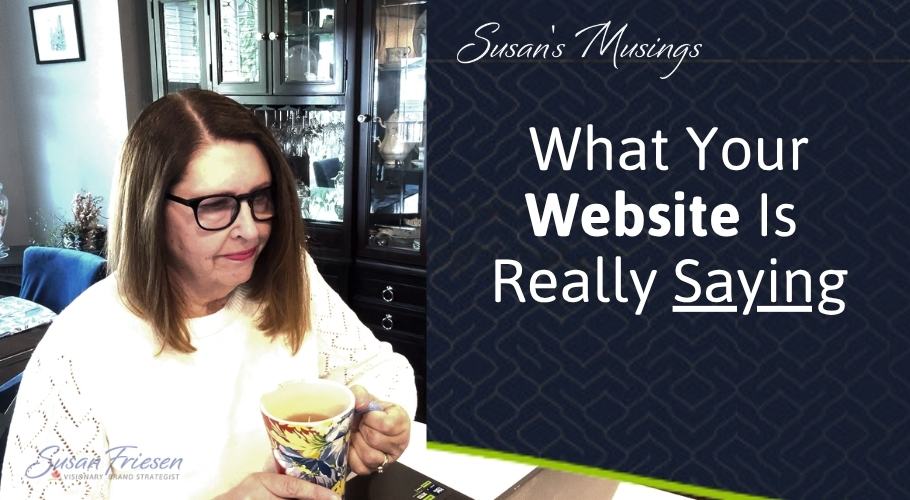
Why your website may be costing you trust
Position first, market second
Have you ever looked at your website and wondered whether it’s truly saying what you think it’s saying?
This past week, I was honoured to be asked to be a judge for the American Horse Publications Equine Media Awards.
These premier awards recognize excellence in equine media across print, digital photography, websites, podcasts, and more. I judged two categories: podcasts and websites.
It was a fascinating exploration into the equine world, but it also reinforced something I’ve been saying for years: Being in a niche is not the same as being well-positioned.
One would think that simply being in the equine industry would be enough of a differentiator, but that wasn’t the case at all. The strongest entries had narrowed their focus into very specific groups.
Some served the Thoroughbred industry, others focused on grooming supplies, another specifically catered to carriage drivers, and yet another was clearly created for kids and equestrian education.
That level of specificity really mattered in my adjudication process.
Because as I went through the website entries, one common theme kept coming up. Even when the organization itself was clear in its mission statement about what it does and whom it serves, many of the websites did not portray that very well.
And that’s where I saw a lot of disconnect happen.
I found myself feeling disappointed with a number of the sites, and honestly, a bit overwhelmed by how many areas needed improvement. I noticed the issue wasn’t that they had a lack of passion or purpose.
The problem was that the website didn’t reflect the strength of the brand behind that passion.
And in the uncertain times that we’re currently experiencing, that separation matters more than ever.
People are more cautious with their money, and even more importantly, they’re also more cautious with their trust.
They are making quicker judgments about professionalism, credibility, and fit. And with so many business owners turning to AI for content creation, it’s easy to end up with messaging that sounds polished but lacks real distinction.
Without a strong brand foundation underneath it, that kind of content can make your business easier to overlook, but not easier to choose.
And that’s why your website cannot afford to be vague, cluttered, or confusing.
A weak headline can miss the chance to tell people they’re in the right place.
A hero section packed with too much information can create overwhelm instead of confidence.
And a missing call to action can leave visitors unsure of what to do next.
And when that happens, even a good business can come across as less professional than it really is.
That’s the costly part. When your value isn’t being positioned in a way your audience can quickly understand.
The websites that did this well stood out immediately.
In fact, the winning entry was a perfect example of what happens when a brand foundation translates beautifully online.
From the first impression, the visual design, colour palette, and playful imagery immediately resonated with its target audience. The site balanced fun and functionality in a way that felt engaging and safe. The structure and hierarchy of information on the home page guided users naturally through the content without overwhelming them.
In other words, the website matched the mission.
And because of that, trust was built almost instantly.
That’s what strong brand positioning does. It brings your business into focus. It helps people feel they understand you. It helps them see that you know exactly whom you help, and what you’re here to help them do. And when that comes across clearly, your marketing works much better because it’s rooted in a solid brand foundation.
But too many business owners skip that part.
They build the website first. Then they start producing content while experimenting with AI, tweaking and adding while they keep pushing more information out into the world, hoping something will work.
But without a strong brand foundation, all that effort can create more noise and confusion instead of more leads and sales.
And in an economy where people are thinking twice before they buy, noise and confusion do not convert.
Trust does.
Relevance does.
A message that makes someone feel understood does.
So, if your website has been sitting there for a while, looking passable but not pulling its weight, this is your reminder to take a closer look.
Does your home page clearly show whom you serve? Does your headline speak to the right people right away? Does your copy guide rather than overwhelm? Does it make the next step obvious?
Most importantly, does your website reflect the brand foundation underneath it, or is it simply taking up space online?
Because when your positioning is strong, your website stops acting like an online brochure and starts acting like a trusted guide.
And that can make all the difference when people are deciding where to spend their money, whom to believe, and which business feels like the safest and smartest choice.
Until next time, I’m Susan Friesen, your small business brand positioning strategist, inviting you to stay clear, stay focused, and stand out.
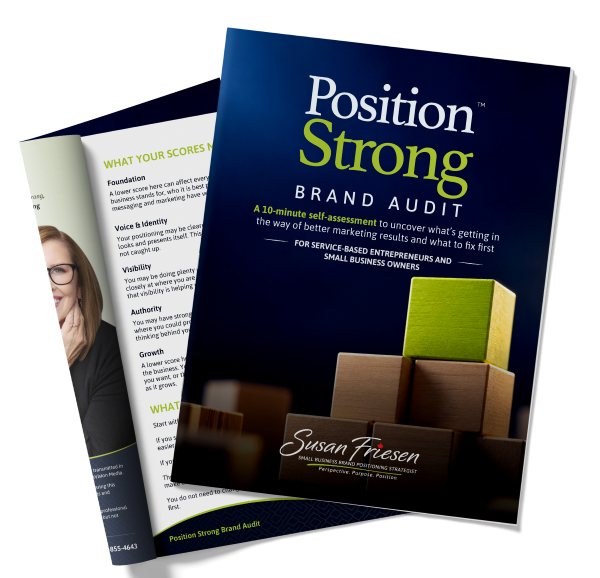
P.S. If your website no longer reflects the quality of your business, start by reviewing your home page with fresh eyes. Then grab my Brand Clarity & Gap Audit to see where your website and marketing may be missing the mark, and what to strengthen so your message builds trust from the very first impression.
Ready to Attract Better Clients Without Working Harder?

You don’t need another crash course in funnels or hacks. You need clarity.
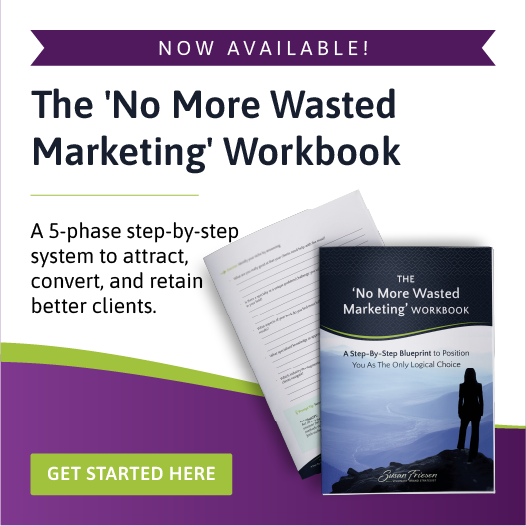
And that’s exactly what you’ll get in The ‘No More Wasted Marketing’ Workbook, a step-by-step guide to help you refine your brand positioning and uncover what makes your business stand out.
This isn’t just a workbook. It’s your roadmap to:
- Marketing that finally feels like it's working
- Offers that feel like a perfect fit (because they are)
- Magnetic messaging that speaks to your ideal client
- A brand that builds trust and authority at first glance
So, if you’re tired of attracting the wrong clients, or none at all, it’s time to change that.
Download The ‘No More Wasted Marketing’ Workbook Now and start building the kind of brand that your best clients just can’t ignore.

About the Author, Susan Friesen
Located in the lower mainland of B.C., Susan Friesen is a visionary brand strategist, entrepreneur, and founder of British Columbia’s premiere boutique web development and digital marketing agency, eVision Media.
With over 20 years of experience in the industry, she is an expert in helping businesses establish their online presence and create a strong brand identity.
Her passion for empowering entrepreneurs and small business owners to succeed in the digital world has earned her a reputation as a leading authority in the branding and marketing industry.
Visit www.BrandIdentitySteps.com and download your FREE guide: "Unlocking Customer Trust and Business Growth: Your 7-Step Guide to Defining a Compelling Brand Identity that Appeals to Your Perfect Clients".